
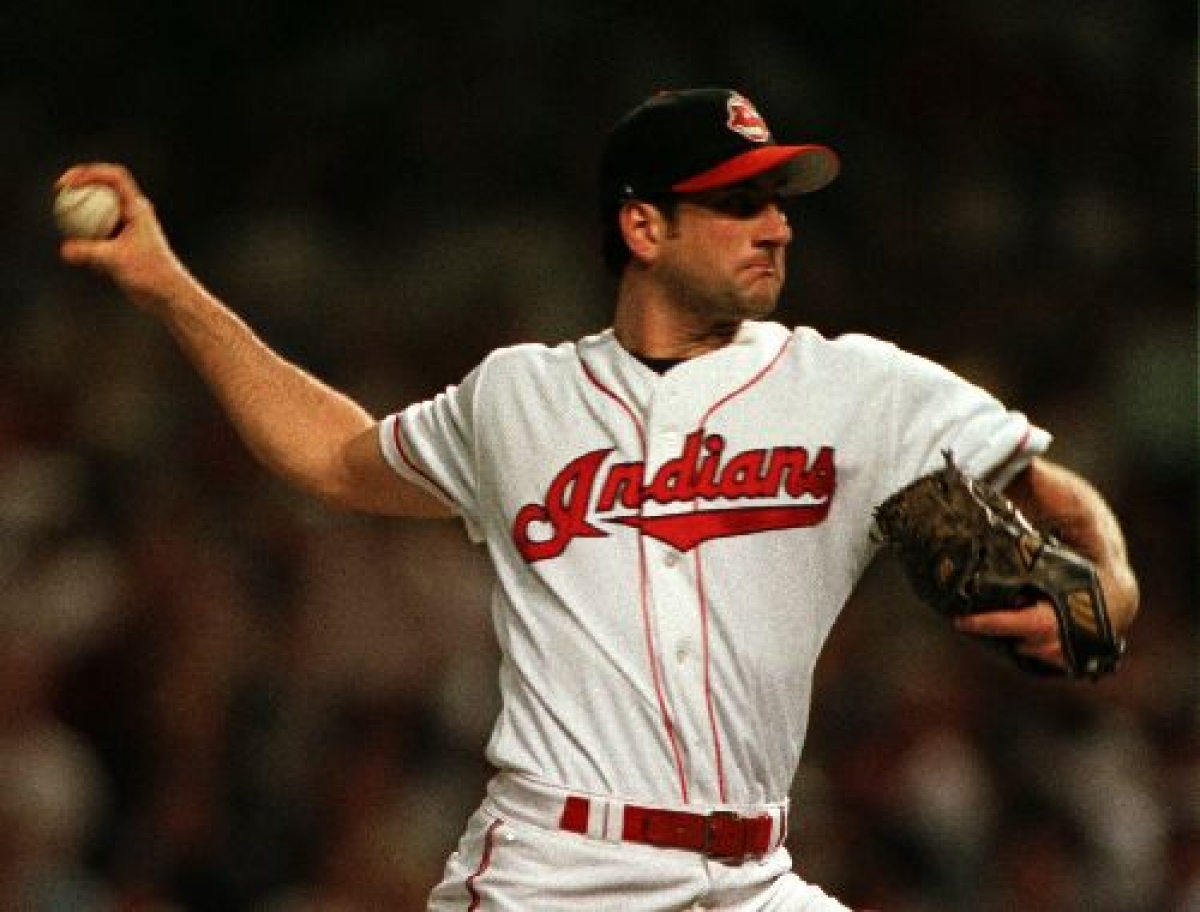

Long before he was a fixture in the Cleveland rotation, Charles Nagy was already a champion, arriving on the North Coast with an Olympic Gold Medal from the 1988 Seoul Games. When he stepped onto the Major League stage in 1990, he traded his national colors for the Tribe’s navy and red, beginning a thirteen-season journey that would see him become the iron man of the franchise's most explosive decade.
Nagy’s career in Cleveland was a study in professional resilience, as he evolved from a young prospect into the staff’s undisputed workhorse. He established himself as a frontline winner during the club's resurgence, authoring a consistent peak that saw him reach the 17-win plateau on three separate occasions. These were not merely volume stats; he was a model of specialized efficiency, earning All-Star honors in each of those 17-win summers and consistently appearing in the top ten of the American League Cy Young voting. He possessed a specialized ability to eat innings, providing a steadying presence for a team that was constantly under the high-leverage pressure of the postseason.
The most profound aspect of his tenure was his role as a statistical titan during the club's legendary run at Jacobs Field. Nagy was a master of the "big game" workload, starting 297 games for the organization and twice leading the league in games started. His craftsmanship reached a statistical summit in the mid-90s, where he finished in the top ten for Pitcher bWAR three times, proving that his value extended far beyond the win-loss column. He served as the tactical engine of a rotation that bridged the gap between the lean years of the early decade and the championship-contending era, securing 129 victories in a Cleveland uniform.
The organization provided the ultimate punctuation on his career in 2007 by inducting him into the Cleveland Hall of Fame.

Comments powered by CComment