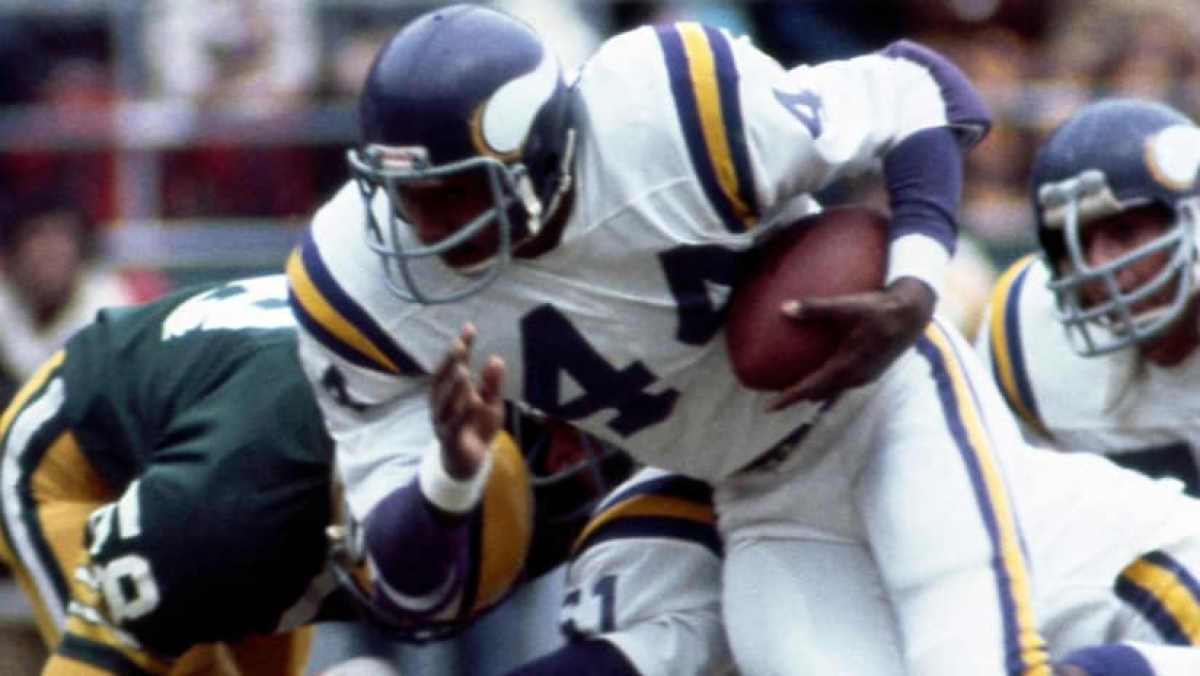
Chuck Foreman arrived in Minnesota as the 12th overall pick in 1973 after a college career at Miami that left scouts unsure whether he belonged at fullback or halfback. Coaches at Miami had told him he would not make it as a running back in the NFL, and he spent the early part of his career determined to prove them wrong. The Vikings gave him the chance, and he made the most of it from the start.
As a rookie, he rushed for 801 yards and caught 37 passes for 362 more, good for 1,163 yards from scrimmage. That production earned him the AP Offensive Rookie of the Year award and helped the Vikings reach the Super Bowl. It was the first of five straight Pro Bowl seasons and the beginning of a stretch in which he became the centerpiece of the Minnesota offense. Foreman ran with a low, spinning style that made him hard to square up. He could cut back against the grain or slip past tacklers in the open field, and he was equally comfortable catching the ball out of the backfield.
In 1974, he improved to 1,363 yards from scrimmage and led the NFL with 15 touchdowns as the Vikings returned to the Super Bowl. The next year brought his peak. Foreman rushed for 1,070 yards on 280 carries, caught a league-leading 73 passes for 691 more, and scored 22 touchdowns. Those totals earned him first-team All-Pro honors and marked the highest single-season output of his career. He followed with another strong year in 1976, rushing for 1,155 yards and scoring 14 touchdowns as the Vikings reached the Super Bowl once more. His combination of volume on the ground and consistent work in the passing game made him one of the league’s most complete backs during that stretch.
He remained productive in 1977 with 1,112 rushing yards, but the production began to fade after that. Knee problems limited him in 1978, and his numbers dropped further in 1979 as the injuries took a lasting toll. By the end of that season, the Vikings traded him to the New England Patriots. He spent one limited year in New England and then retired. With Minnesota, he finished with 5,887 rushing yards, 3,057 receiving yards, and 8,944 yards from scrimmage across seven seasons. Those numbers, paired with 75 total touchdowns, ranked him among the most productive dual-threat backs of the 1970s.
The Vikings placed him in their Ring of Honor in 2007. The honor recognized a player who turned early doubts about his position into a career that defined the Vikings’ offense during their most successful stretch of the decade.
Comments powered by CComment