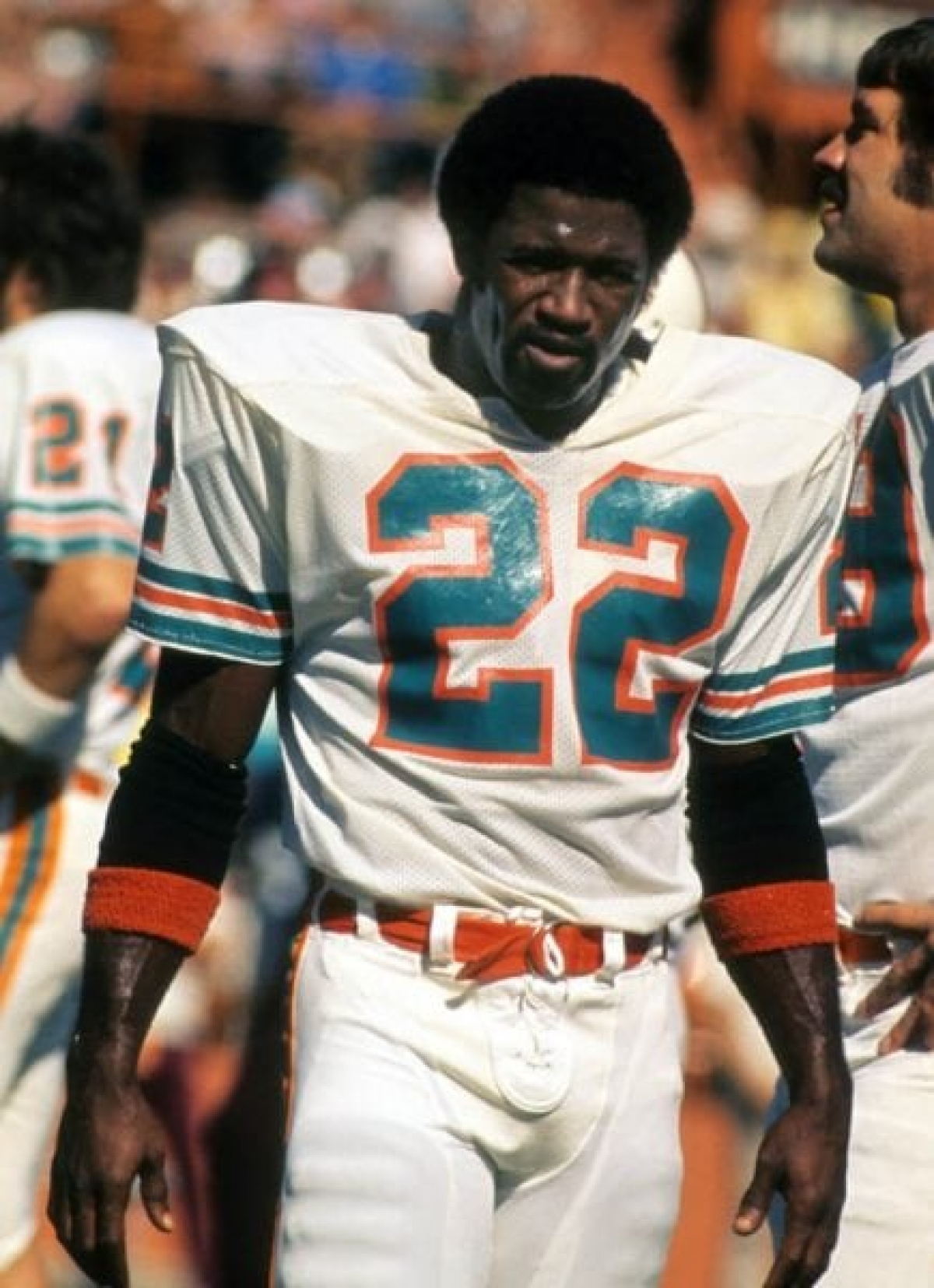
The Miami Dolphins were already loaded at the back position with Larry Csonka and Jim Kiick, but they had another considerable weapon in Eugene “Mercury” Morris. The product of West Texas State was used mostly as a returner early on, and as a rookie in 1969 he led the league in kick return yards (1,136) and total return yards (1,308). Those early returns showed the speed that would eventually force its way into the offense, even if the Dolphins already had two established backs.
He slowly saw more work as a running back and went to the Pro Bowl three years in a row from 1971 to 1973. In 1972, he finished with an even 1,000 rushing yards on 190 carries (5.3 yards per attempt) and led the NFL with 12 touchdowns from the ground. That was the year the Dolphins went undefeated and won their first Super Bowl. He and Csonka became the first teammates in NFL history to each clear 1,000 yards in the same season, and Morris averaged better than five yards a carry while scoring at a rate that kept defenses honest even when they keyed on Csonka. A late statistical correction from a disputed lateral earlier in the year is what pushed him exactly to the thousand-yard mark.
Morris and the Dolphins won the Super Bowl again in 1973, with the running back going for 954 yards and 10 touchdowns while leading the league in yards per attempt (6.4) and yards per touch (6.6). He was injured through most of 1974, and while he returned in 1975 with 875 yards from the ground, he was traded to the San Diego Chargers afterward.
With Miami, he finished with 3,877 rushing yards, a 5.1 career yards-per-carry average, and 7,794 all-purpose yards. The Dolphins later inducted him into the College Football Hall of Fame.


Comments powered by CComment