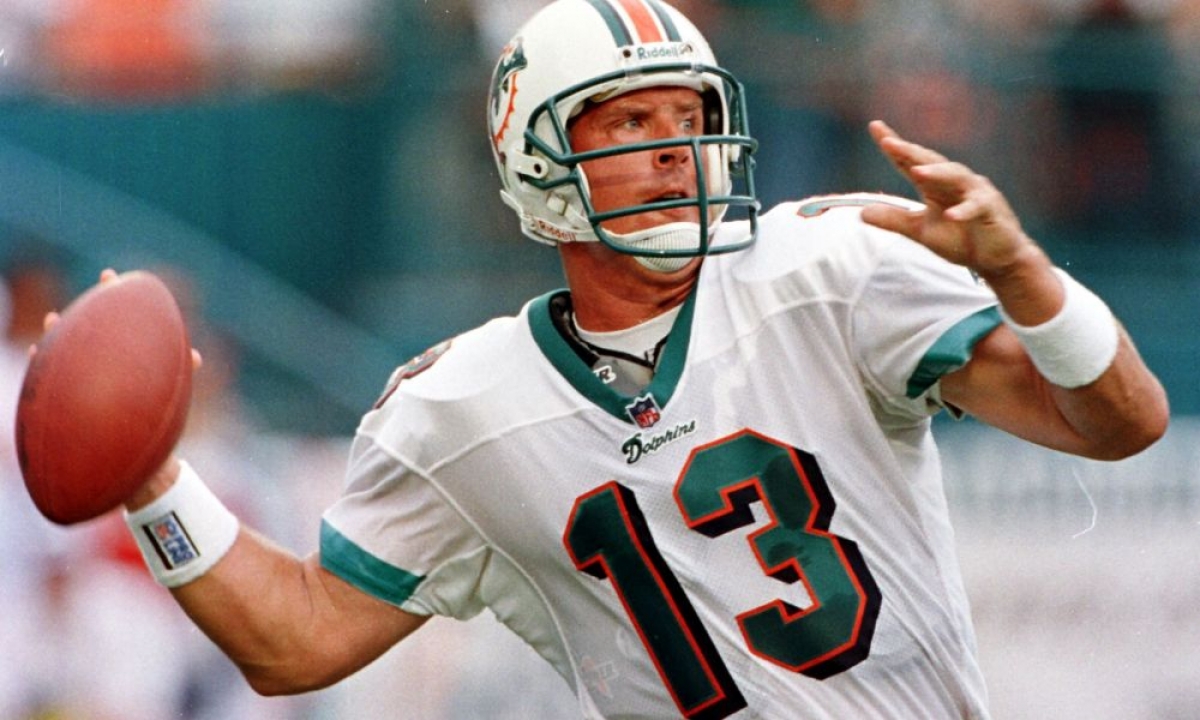
The 1983 NFL Draft lives in football lore as the legendary "Year of the Quarterback," a frantic first-round frenzy where five passers—John Elway, Todd Blackledge, Jim Kelly, Tony Eason, and Division II product Ken O'Brien—were swept off the board early. Sitting near the bottom of the round after coming off a Super Bowl appearance, the Miami Dolphins watched in absolute disbelief as Dan Marino, a consensus collegiate phenom out of Pittsburgh, unexpectedly plummeted down draft boards due to unproven rumors and pre-draft paranoia. When Miami snatched Marino with the 27th overall pick, they didn't just capitalize on one of the greatest draft-day steals in sports history; they reshaped the parameters of professional passing forever.
Marino made the teams that passed on him pay almost immediately. Taking over the starting quarterback role midway through his 1983 rookie campaign, he took the league by storm with a 7–2 starting record, 20 touchdown passes, a Pro Bowl selection, and PFWA All-Rookie Team honors. But that stellar introductory run was merely a prelude to the most explosive three-year passing stretch the gridiron had ever witnessed.
From 1984 to 1986, Marino accomplished a feat unmatched in NFL history, leading the league in completions, passing yards, and passing touchdowns in three consecutive seasons while earning First-Team AP All-Pro honors each year. His legendary 1984 sophomore campaign fundamentally altered the sport: Marino shattered existing aerial records by becoming the first quarterback to cross the 5,000-yard threshold (5,084) while throwing an unheard-of 48 touchdown passes. Named the NFL MVP and Offensive Player of the Year, he powered Miami to a 14–2 record and an AFC Championship title, driving the Dolphins to Super Bowl XIX.
Though Miami fell to San Francisco in the championship game, Marino established himself as the premier, undisputed passing force of his era. He followed up his historic MVP year by throwing for 4,137 yards and 30 touchdowns in 1985—handing the eventual champion 1985 Chicago Bears their lone defeat of the season—and backed that up with 4,746 yards and 44 touchdown passes in 1986.
Marino led the NFL in passing yards five separate times throughout his career and earned nine total Pro Bowl selections. Lacking mobility in the pocket, he never needed to run. Armed with the fastest, smoothest release in football history and unmatched downfield accuracy, Marino turned solid receivers like Mark Duper and Mark Clayton into lethal, perennial All-Pro weapons.
Throughout his 17-year run in South Florida, a consistent running game and elite defensive support rarely materialized around him. Yet despite those perpetual roster deficiencies, as long as No. 13 was behind center, the Dolphins were an immediate Super Bowl threat. His supernatural pocket instincts and quick release allowed him to neutralize pass rushes effortlessly, leading the NFL in lowest sack percentage in ten different seasons.
What Marino achieved in the 1980s and 1990s was entirely unprecedented, operating in a far more physical era for pass defenses before modern rules protected quarterbacks and receivers. While eventual rule changes allowed modern passers to challenge his single-season marks decades later, the sheer distance between Marino and his contemporaries during his prime remains utterly staggering.
When he finally hung up his cleats following the 1999 season, Marino stood alone at the summit of gridiron history as the all-time leading passer, holding every major cumulative throwing record, including completions (4,967), passing yards (61,361), and passing touchdowns (420). Marino never did win the Super Bowl, but nobody, and we mean nobody, ever placed the blame on the legendary quarterback.
Marino was inducted into the Pro Football Hall of Fame in 2005 during his first eligibility, and was later named to the NFL 100th Anniversary All-Time Team. The Dolphins retired his No. 13 jersey and added him to the Miami Dolphins Honor Roll in 2000.
Comments powered by CComment