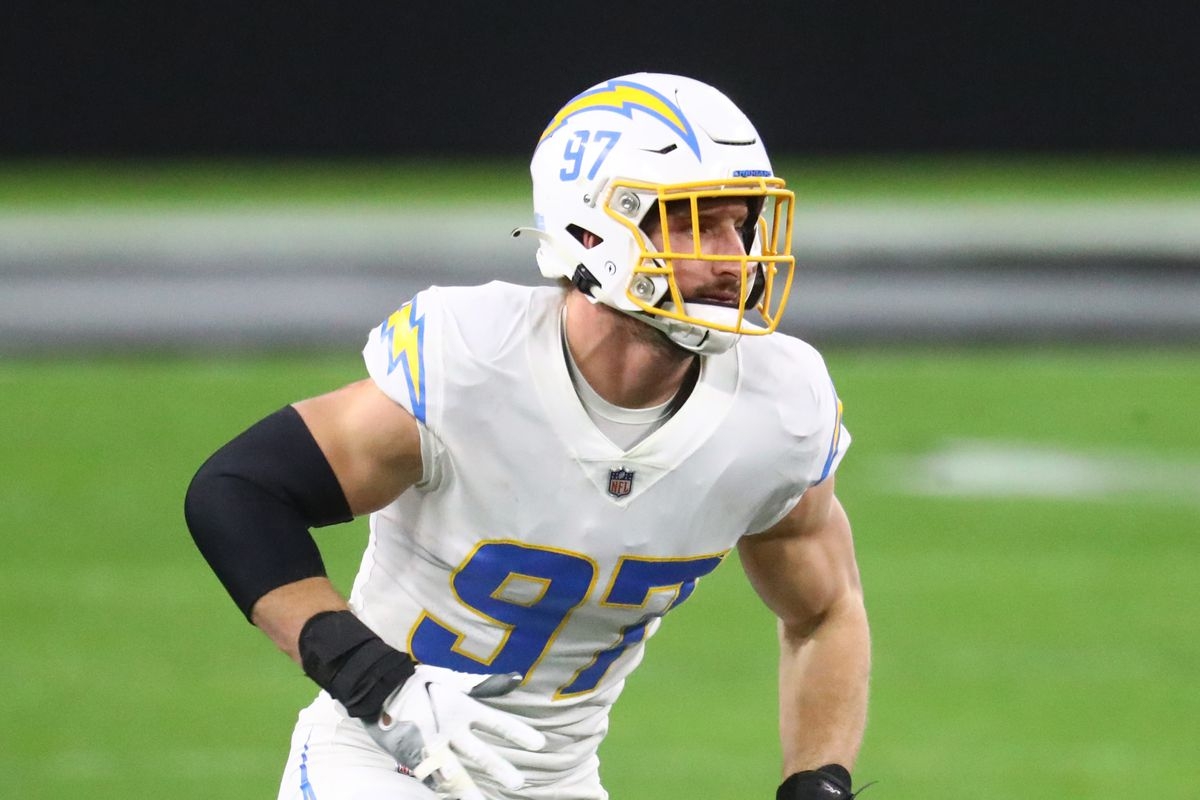
Joey Bosa came to the Chargers as the third overall pick out of Ohio State in 2016 after a dominant college career that included two All-American honors, the Nagurski-Woodson Defensive Player of the Year award, and a national title. The big, explosive edge rusher from the Buckeyes wasted little time proving the selection was right. In a 2016 season that earned him Defensive Rookie of the Year honors, he posted 10.5 sacks and 17 tackles for loss (second in the league) despite a contract holdout that delayed his debut. He was a power-speed hybrid who used violent hands, a quick first step, and relentless effort to collapse the pocket or set the edge against the run. He set an early NFL mark by recording 19 sacks through his first 20 games, giving the Chargers an immediate difference-maker off the edge.
He followed that up with a 12.5-sack season in 2017 and his first Pro Bowl. Injuries limited him to seven games in 2018, but he bounced back with Pro Bowl selections in 2019, 2020, and 2021 while continuing to rank among the league’s better pass rushers when healthy. He teamed with Melvin Ingram for stretches to form one of the more disruptive edge duos in the AFC. In 2022, a groin injury cost him most of the regular season; when he returned for the playoffs, a penalty for removing his helmet helped seal a Wild Card loss to Jacksonville. Injuries kept coming after that, and while he still earned a fifth Pro Bowl nod in 2024, he was no longer the consistent force he had been earlier in his career, finishing as a solid but diminished contributor in his final two seasons. Even so, he remained a reliable presence when available, still capable of generating pressure and forcing offenses to account for him on every snap.
The Chargers released him after the 2024 season. Across nine years with the franchise, he left with 72 sacks and 87 tackles for loss, production that ranks second in team history for sacks and marked him as one of the most productive edge rushers the Chargers have ever had.
He was the last remaining player who had been with the organization continuously from its final years in San Diego through the move to Los Angeles, and his early dominance helped set a standard for the pass rush that the team has been trying to rebuild around ever since.
Comments powered by CComment