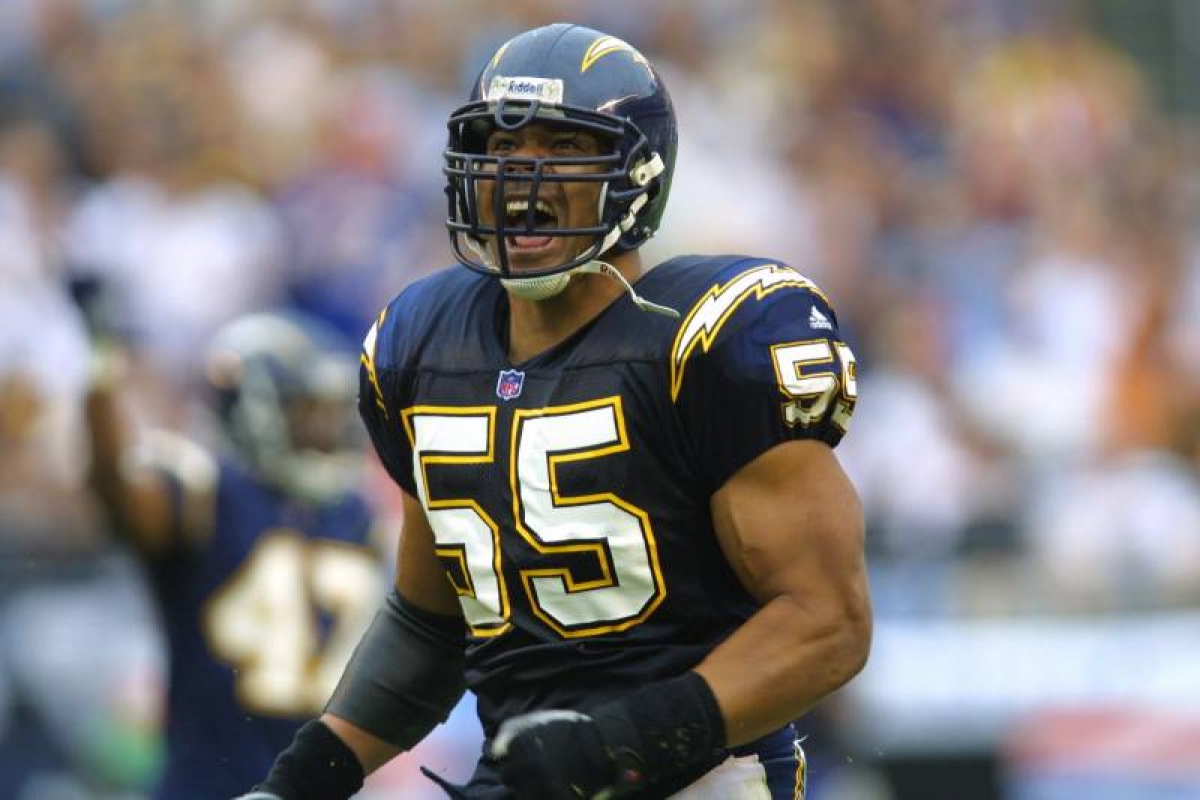
Born and raised in nearby Oceanside before starring at USC, Tiaina Baul "Junior" Seau Jr. did not just sign with the San Diego Chargers as the fifth overall pick in the 1990 NFL Draft—he inherited a kingdom that already claimed him as its own. When the local franchise turned in his card, it forged a bond between a native son and a region that would redefine Chargers football culture for more than a decade.
Seau wasted no time establishing his presence on the field, stepping into the starting lineup as a rookie and showcasing a kinetic style of play that earned him the moniker "The Tasmanian Devil." Blessed with rare closing speed, sideline-to-sideline range, and uncannily accurate pre-snap instincts, Seau played middle linebacker with an infectious, uncontrolled intensity. He did not merely diagnose plays; he shot gaps, blew up blocking schemes, and met ball-carriers in the backfield before development could even begin.
By his second season in 1991, Seau earned his first Pro Bowl selection, beginning one of the most dominant individual runs in NFL history. He became the unquestioned emotional heartbeat and physical engine of the Chargers defense, leading San Diego to a division title in 1992 and earning NFL Defensive Player of the Year honors from the Newspaper Enterprise Association (NEA). His passionate leadership transformed the locker room culture, instilling a fierce defensive identity that defined the franchise throughout the decade.
The high-water mark of Seau's team success arrived during the magical 1994 campaign. Serving as the primary captain and leader of a gritty Chargers squad, Seau delivered an iconic postseason performance in the AFC Championship Game against the Pittsburgh Steelers. Playing through a severe pinched nerve in his neck, Seau recorded a staggering 16 tackles, single-handedly keying a goal-line stand and pulling off a dramatic 17–13 upset to propel San Diego to Super Bowl XXIX—the first and only Super Bowl appearance in franchise history.
Seau’s individual accolades during his time in San Diego place him among the elite linebackers ever to play the game. From 1991 through 2002, he was selected to 12 consecutive Pro Bowls in a Chargers uniform. He earned First-Team AP All-Pro honors six times (1992–1996, 1998) and Second-Team honors twice more, firmly establishing himself as the premier linebacking force of his era alongside contemporaries like Mike Singletary and Ray Lewis.
Off the field, Seau was equally revered in San Diego for his philanthropy and civic engagement. Through the Junior Seau Foundation, established in 1992, he raised millions of dollars to support child abuse prevention, drug and alcohol awareness, and educational programs for underprivileged youth across Southern California. His selfless community work earned him the prestigious Walter Payton NFL Man of the Year Award in 1994, cementing his status as a beloved civic icon.
After 13 glorious seasons in San Diego, the Chargers traded Seau to the Miami Dolphins in 2003, where he spent three seasons before closing his storied 20-year NFL career with four years as a respected veteran leader for the New England Patriots. Across his two decades in the league, Seau appeared in 268 regular-season games (243 starts), making two Super Bowl appearances and earning a spot on the NFL 1990s All-Decade Team.
Tragedy struck the football world in May 2012 when Seau died by suicide at age 43. Subsequent brain tissue studies revealed he suffered from Chronic Traumatic Encephalopathy (CTE), a degenerative brain disease linked to repetitive head impacts. His tragic death sparked nationwide conversations regarding player safety and long-term neurological health, while his family and foundation continued advocating for head trauma research in his memory.
The Chargers inducted Seau into their Hall of Fame in 2011 and retired his No. 55 jersey in 2012 after his passing. He was posthumously enshrined in the Pro Football Hall of Fame in 2015 and named to the NFL 100th Anniversary All-Time Team in 2019.
With the Chargers, Seau compiled 1,480 combined tackles (1,185 solo, 293 assists), 47.0 sacks, 15 interceptions, 14 forced fumbles, and 11 fumble recoveries.
Comments powered by CComment