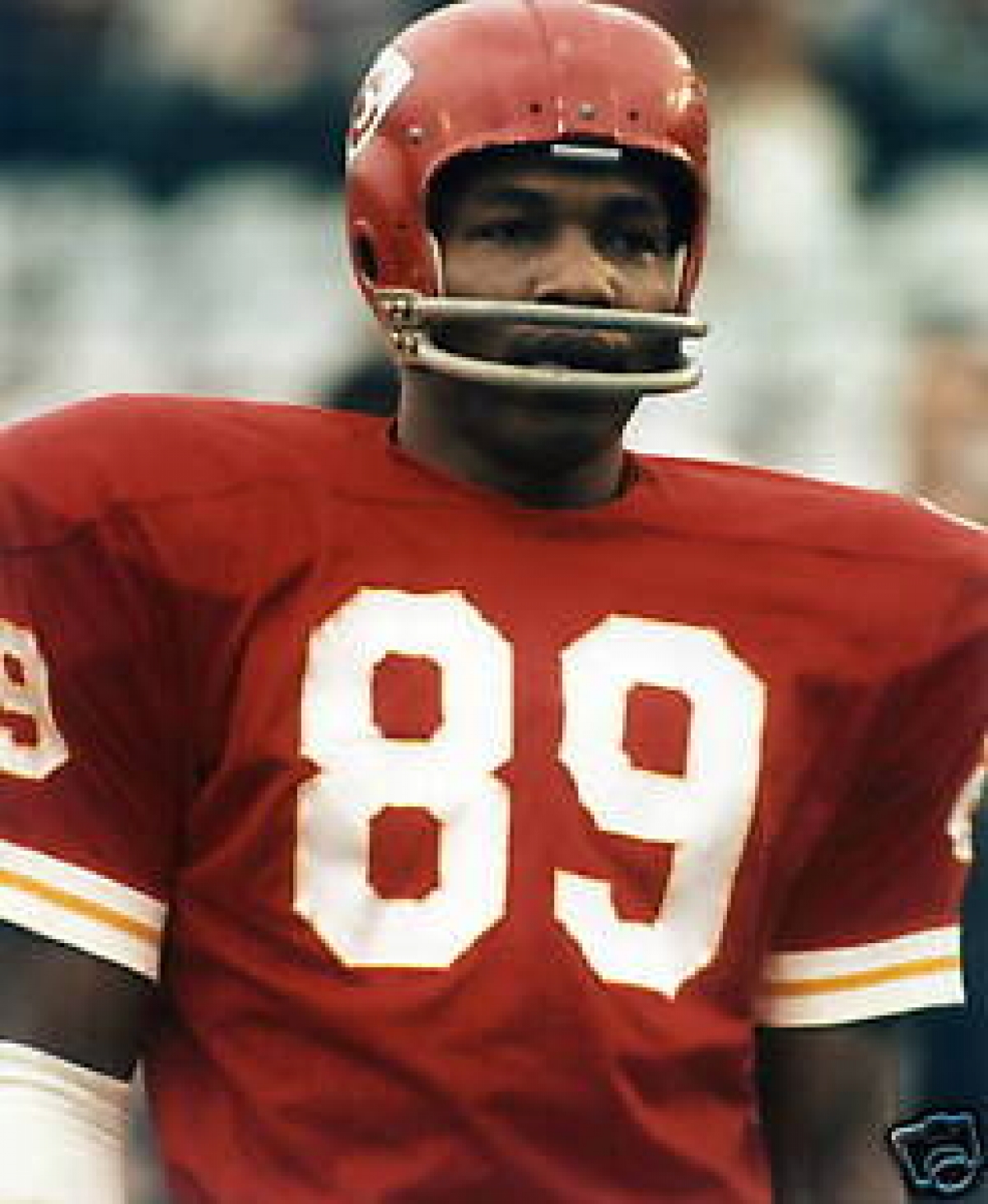
During the Kansas City Chiefs' golden era, Hank Stram’s defense rightfully stole the national headlines. Packed with future Hall of Fame titans like Willie Lanier, Buck Buchanan, Bobby Bell, and Emmitt Thomas, that defense choked out opponents and defined the franchise's identity. Yet, focusing solely on the defensive side of the ball ignores a crucial reality: Kansas City possessed a lethal offensive weapon capable of breaking any game open in a single stride, and his name was Otis Taylor.
Selected in the fourth round of the 1965 AFL Draft out of Prairie View A&M—while the NFL's Philadelphia Eagles also targeted him—Taylor chose the upstart AFL and stepped right into the lineup. Blessed with a towering 6-foot-3 frame, smooth long-striding speed, and raw physicality, he brought an imposing presence to both wide receiver and flanker. He quickly established an electric connection with Len Dawson, posting 26.4 yards per catch as a rookie before exploding for 1,297 receiving yards and eight touchdowns in his second season to help secure the 1966 AFL Championship.
As the decade turned, Taylor cemented his legacy in gridiron lore during the 1969 postseason run that culminated in Super Bowl IV. Facing the heavily favored Minnesota Vikings in the rain at Tulane Stadium, Taylor delivered the iconic highlight that put the game out of reach. Catching a short hitch pass from Dawson, he stiff-armed cornerback Karl Kassulke, broke a tackle along the sideline, and sprinted 46 yards into the end zone for the game-clinching score in a 23–7 triumph that crowned Kansas City world champions.
While the Super Bowl ring sealed his big-game reputation, Taylor's individual peak came in the early 1970s. His signature year came in 1971, when he dominated secondary after secondary to lead the NFL with 1,110 receiving yards on 57 catches (19.5 average) and seven touchdowns. That staggering display earned him consensus AP First-Team All-Pro selection and a Pro Bowl invitation, validating him as arguably the most dominant wideout in professional football.
He followed up that standout campaign with another First-Team All-Pro performance in 1972, hauling in 821 yards and six touchdowns despite defenses slanting their coverages entirely toward his side of the field. His rare combination of size and perimeter muscle allowed him to muscle through press coverage, snag high-pointed throws over smaller cornerbacks, and turn short screens into long gains.
Wear and tear eventually slowed the veteran wideout over his final three seasons in Kansas City, but his loyalty never wavered. Taylor spent all eleven of his active professional seasons in a Chiefs uniform (1965–1975), remaining the ultimate team leader through the transition years of the mid-1970s before hanging up his cleats following the 1975 campaign as one of the ultimate single-franchise legends of his generation.
Taylor accumulated 410 receptions, 7,306 receiving yards (17.8 Y/R), 57 receiving touchdowns, and three rushing scores, and was inducted into the Kansas City Chiefs Hall of Fame in 1982.
Comments powered by CComment