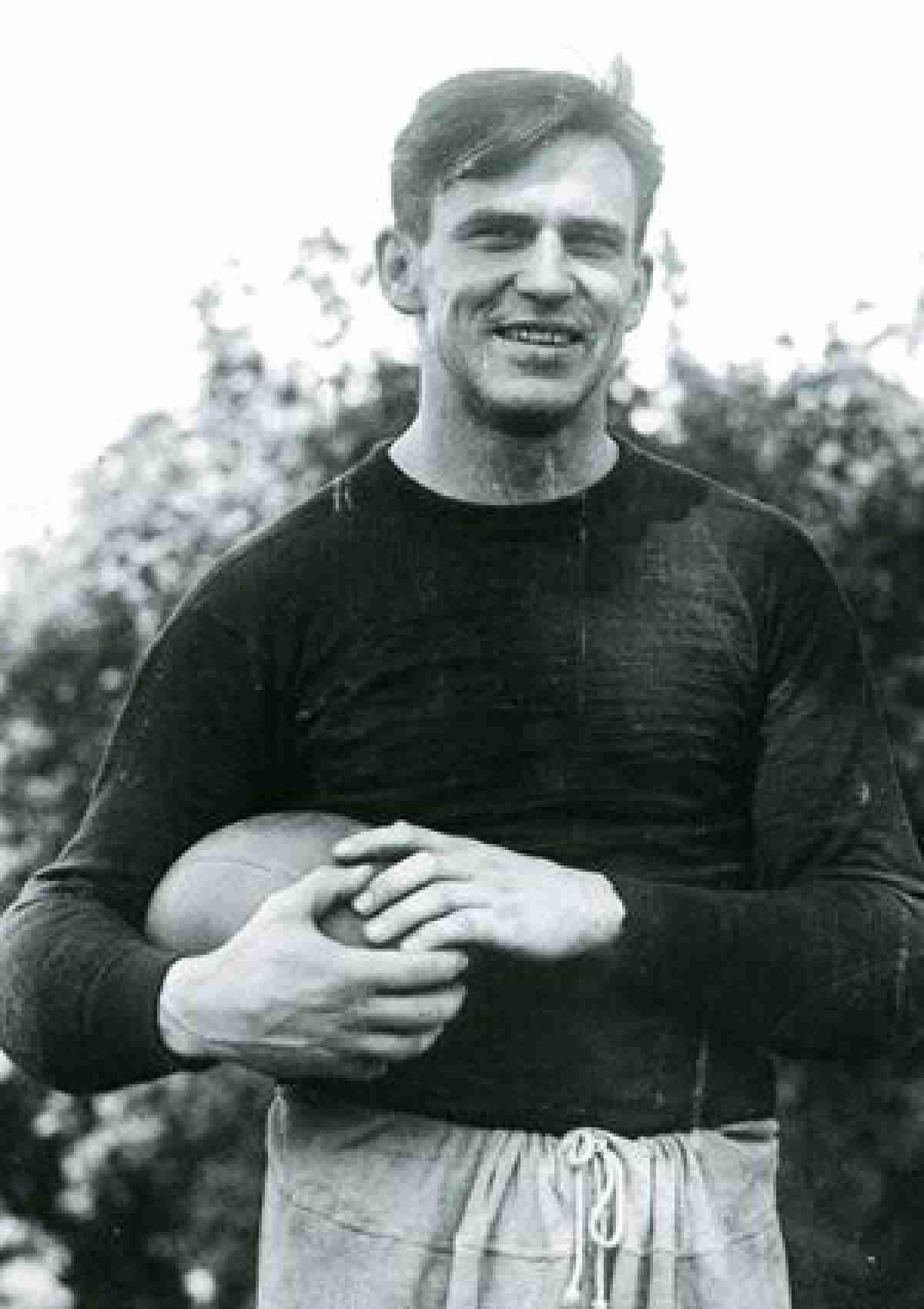
Born John Victor McNally, the colorful halfback famously adopted the pseudonym "Johnny Blood"—inspired by the 1922 Rudolph Valentino film Blood and Sand—to protect his remaining college athletic eligibility while playing for pay. A vagabond gridiron genius who barnstormed with Ernie Nevers’ Duluth Eskimos, McNally arrived in Green Bay in 1929 when Curly Lambeau recognized that his explosive open-field speed, eccentric personality, and game-breaking ability could turn the Packers into a world power.
Operating as a versatile halfback, receiver, defensive back, and kick returner, McNally served as the dynamic catalyst for pro football's first three-peat championship squad. With his rare blend of vertical speed and acrobatic ball skills, he became Arnie Herber's favorite long-distance target, leading Green Bay to consecutive NFL titles in 1929, 1930, and 1931. His flair for the dramatic and legendary off-field exploits only enhanced his status as one of the Roaring Twenties and Thirties' most captivating athletic figures.
After spending 1934 with the Pottsville Maroons and local independent clubs, McNally returned to Titletown in 1935 for a second tenure. His veteran presence and big-play knack provided crucial punch for Lambeau’s 1936 squad, culminating in a 21–6 championship victory over the Boston Redskins for his fourth NFL title in Green Bay.
Following his final stint in Green Bay, McNally served as player-coach for the Pittsburgh Pirates (later the Steelers) before retiring from active play. His enduring impact on the early evolution of the passing game earned him a spot on the NFL 1930s All-Decade Team.
In 1963, McNally was enshrined in the inaugural charter class of the Pro Football Hall of Fame in Canton, Ohio. Seven years later, in 1970, the Green Bay Packers formally honored his founding role in their championship lineage by inducting him as a charter member of the Green Bay Packers Hall of Fame. With the Packers, he had 37 total touchdowns.
Comments powered by CComment