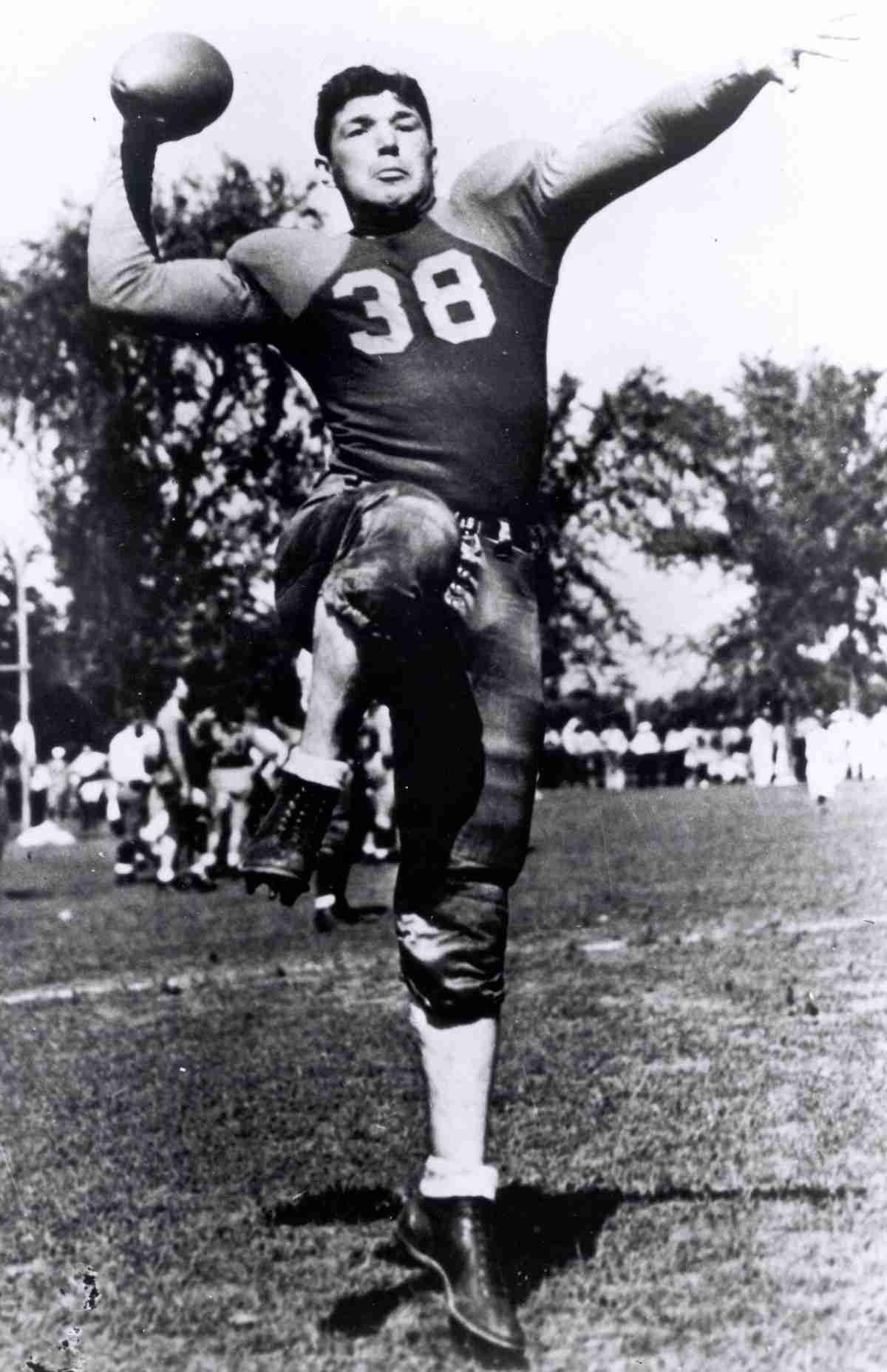
Growing up in Green Bay and working as a handyman in the Packers' clubhouse after a brief collegiate stint, Arnie Herber took one of the most improbable paths to gridiron immortality. Head coach Curly Lambeau handed the local 20-year-old a tryout in 1930, uncovering a natural long-distance passer whose cannon arm would revolutionize pro football's aerial attack.
Herber introduced a new style of play not seen before in the dead-ball era, gripping the football with all five fingers on the laces and launching long passes downfield. Lambeau frequently praised Herber's exceptional vertical accuracy, noting that his long throws over 40 yards were more effective than most quarterbacks’ 30-yard passes of that time. Once the NFL started tracking official stats in 1932, Herber immediately won the first passing title with 639 yards and nine touchdowns. He also led the league in passing again in 1934, cementing his status as the era's top aerial threat.
Herber's career—and the NFL's direction—took a sharp turn in 1935 with rookie split end Don Hutson's debut. The pair quickly created history as pro football's first legendary passing duo, debuting with an 83-yard touchdown on Hutson's first NFL reception against Chicago. Their partnership peaked in 1936 when Herber became the first in league history to surpass 1,000 passing yards, setting records with 1,239 yards and 11 touchdowns in a single season.
Herber’s deep ball powered Green Bay to four NFL Championships (1930, 1931, 1936, 1939). In the 1936 title game against the Boston Redskins, Herber threw two touchdown passes—including a 48-yard strike to Hutson—to secure a 21–6 victory and bring the championship back to Titletown.
Herber retired following the 1940 campaign as the NFL's co-all-time leader in touchdown passes, though he briefly returned during World War II to play two final seasons with the New York Giants. His foundational contributions as football's first true deep threat earned him induction into the Pro Football Hall of Fame in 1966, followed by his entry into the Green Bay Packers Hall of Fame in 1972.
With Green Bay, Herbert had 410 completions, 1,009 passing attempts, 6,749 passing yards, 66 passing touchdowns, 90 interceptions, and 201 rushing yards.


Comments powered by CComment