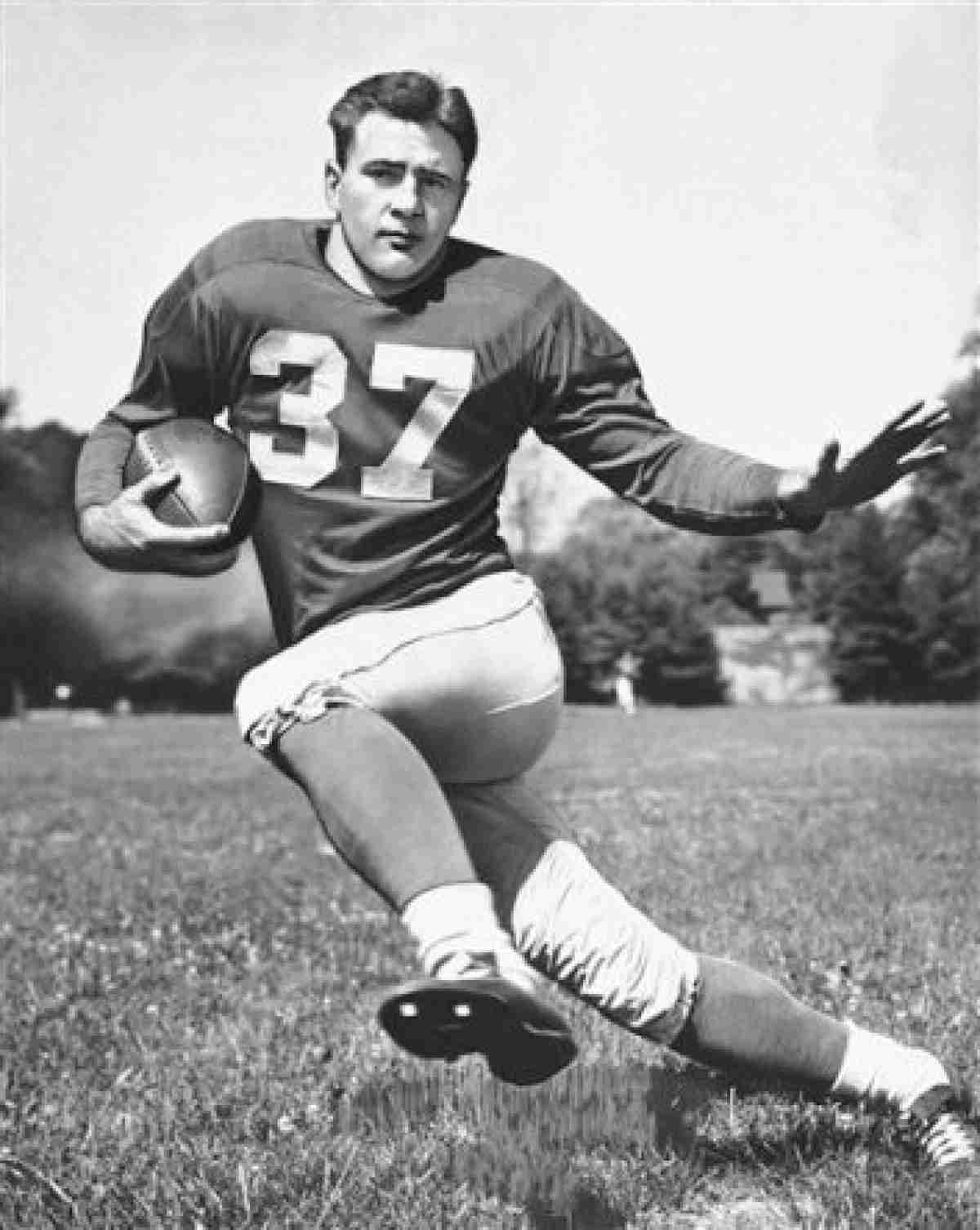
Drafted third overall in 1949 after an iconic collegiate tenure at SMU—where he won the 1948 Heisman Trophy and became such an institution that the national award for college football's top running back bears his name—Doak Walker stepped onto the professional stage carrying massive expectations. At 5-foot-11 and 173 pounds, critics openly questioned whether his lightweight frame could handle the physical toll of the NFL. Walker answered those doubts instantly, claiming Rookie of the Year honors in 1950 while leading the entire league in scoring with 128 points, racking up 11 touchdowns from scrimmage alongside 38 extra points and eight field goals.
Walker's impact on the game extended far beyond standard rushing charts. Operating as a halfback, wide receiver, placekicker, punter, and defensive back, he stood as the ultimate multi-dimensional threat in an era defined by two-way ironmen. Though his rushing total (1,520 career yards) appeared modest on paper, his versatility kept opposing coaches up at night; he averaged a remarkable 16.7 yards per reception out of the backfield, accumulating 2,539 receiving yards and 21 touchdown catches across his six seasons in Honolulu Blue.
That diverse skill set fueled Detroit's early 1950s dominance. Reuniting with his Highland Park High School teammate Bobby Layne, Walker became a clutch offensive playmaker who excelled at turning key moments in championship games. In the 1952 NFL Championship against Cleveland, he ended a scoreless tie with a memorable 67-yard touchdown run down the sideline, helping Detroit secure a 17–7 win. The next year, in the 1953 rematch against the Browns, Walker scored Detroit's first touchdown and later kicked the crucial extra point in a narrow 17–16 victory.
Walker concluded his career in 1955 with a remarkable individual performance, securing his second NFL scoring title with 96 points and earning his fifth Pro Bowl selection. At only 28 years old and at the height of his skills, he surprised the football world by retiring. When asked about his choice, Walker succinctly stated that he had achieved all his on-field goals, was in good health, and was prepared to focus on business pursuits outside football.
Walker played six seasons in Detroit (1950–1955), appearing in 67 games, with 1,520 rushing yards, 2,539 receiving yards, and 33 touchdowns. He also kicked 49 field goals and 183 extra points for 534 total points. A four-time First-Team All-Pro and NFL 1950s All-Decade Team member, his No. 37 jersey was retired by the Lions. Inducted into the Pro Football Hall of Fame in 1986, he became a Pride of the Lions charter member in 2009.
Comments powered by CComment