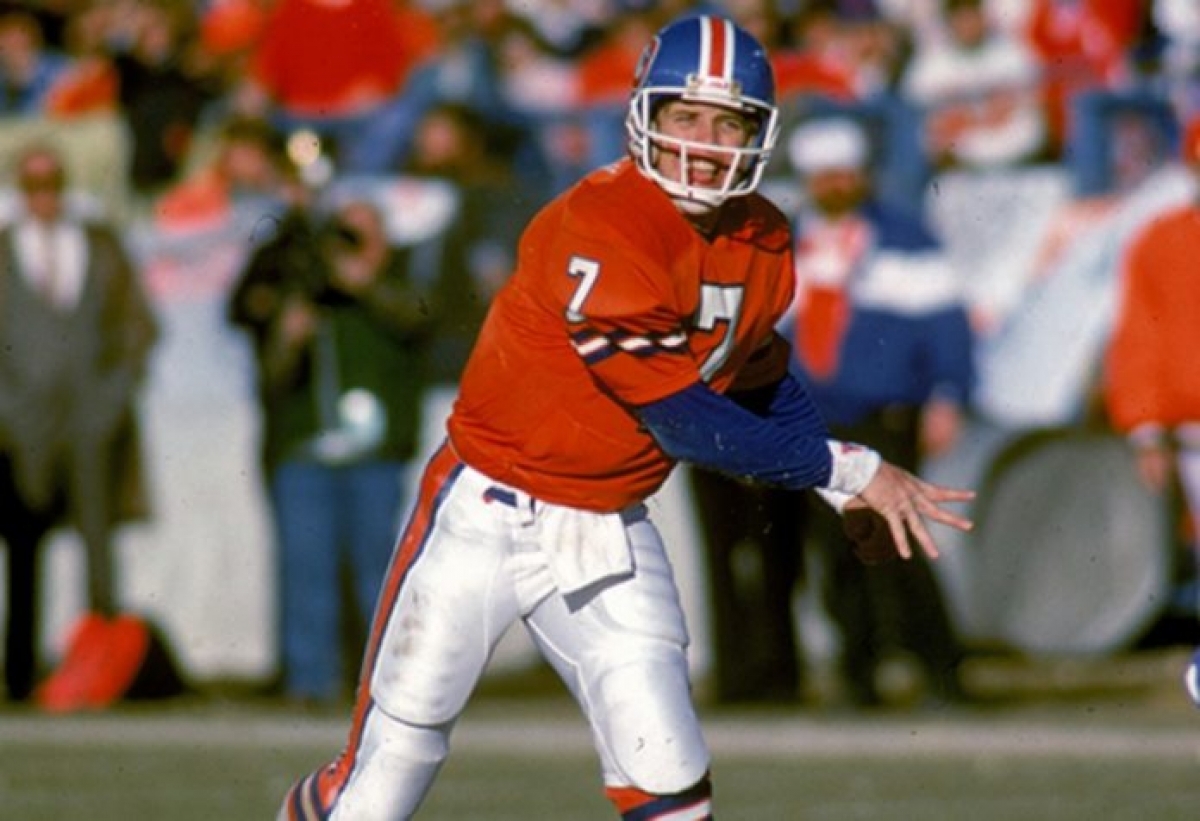
The 1983 Draft had a lot of drama.
John Elway, who was selected first overall in the 1983 NFL Draft by the Baltimore Colts from Stanford University, was renowned for possessing the most celebrated combination of arm strength, athletic mobility, and field vision among his peers. Having explicitly expressed his intention not to play on the East Coast for Baltimore—leveraging his status as a top draft prospect of the New York Yankees to compel a transfer—he persuaded the Colts to trade his rights to the Denver Broncos. Under the leadership of head coach Dan Reeves, Elway faced immediate challenges as a rookie. Nevertheless, he quickly developed into one of the most dynamic playmakers in the history of football, utilizing his mobility to evade collapsing pockets and delivering off-platform throws that redefined the role of the quarterback.
Elway demonstrated exceptional arm strength, capable of delivering precise deep passes on a line, complemented by uncommon speed and physical resilience as a runner. Excelling in heavy bootleg and scramble-drill scenarios, he thrived when structured plays collapsed. His notable mobility enabled him to manipulate pursuit angles, employing his legs to secure vital third downs or to buy time outside the pocket before accurately delivering long throws downfield.
Elway’s reputation as a distinguished performer on significant stages was exemplified during the 1986 AFC Championship Game against the Cleveland Browns. With a deficit of one touchdown and 5:32 remaining, and situated at his own 2-yard line, Elway meticulously directed a 15-play, 98-yard touchdown drive—commonly known as "The Drive"—to compel overtime, ultimately leading Denver to secure a position in Super Bowl XXI. Despite Denver’s defeat by the New York Giants' formidable defense, Elway had already cemented his status as the preeminent late-game strategist in the National Football League.
The following year, Elway captured the 1987 AP NFL Most Valuable Player award after throwing for 3,198 yards and 19 touchdowns, while adding 304 yards and four scores on the ground. He led Denver back to Super Bowl XXII, though the campaign ended in a blowout loss to Washington. Two seasons later, Elway led another Denver roster to the championship stage in Super Bowl XXIV, only to suffer a third defeat at the hands of the San Francisco 49ers.
Despite the uneven postseason outcomes during his initial championship pursuits, Elway consistently maintained his status as an elite regular-season performer. Over the course of his 16-year career, he was selected to nine Pro Bowls and received three Second-Team All-Pro honors (1987, 1993, 1996). He led the entire NFL in passing yards in 1993 with a career-high 4,028 yards, continuously improving his pre-snap decision-making and pocket mechanics as he gained experience.
Throughout the late 1980s and early 1990s, Elway consistently enhanced the talent surrounding him, establishing late-game fourth-quarter comebacks as his distinctive hallmark. By the time Head Coach Mike Shanahan joined in 1995, Elway had acquired the veteran expertise necessary to proficiently operate a sophisticated, movement-oriented West Coast offensive scheme that capitalized on his deep-ball accuracy off play-action fakes.
The incorporation of Terrell Davis and Shanahan's zone-blocking strategy furnished Elway with the well-balanced offensive support he lacked earlier in his career. During Super Bowl XXXII, Elway executed his most renowned physical play—the celebrated "Helicopter" run on third down, which facilitated a touchdown—as Denver triumphed over the Green Bay Packers with a score of 31-24, securing the franchise's inaugural Lombardi Trophy.
Elway returned for one final campaign in 1998, leading Denver to a 14-2 regular-season record. He capped his legendary career in Super Bowl XXXIII, throwing for 336 yards and a touchdown while scoring another on the ground in a 34-19 victory over the Atlanta Falcons. Named Super Bowl MVP in his final professional contest, Elway walked off the field as a back-to-back world champion.
Elway played all 234 of his regular-season games with the Denver Broncos. During his career, he threw for 51,475 yards and 300 touchdowns, and also rushed for 3,407 yards and 33 touchdowns. He ended his playing days holding the NFL record for fourth-quarter comebacks by a quarterback with 47.
In 1999, the franchise expedited Elway's induction into the Denver Broncos Ring of Fame and officially retired his No. 7 jersey. Subsequently, in 2004, he was inducted into the Pro Football Hall of Fame during his first year of eligibility. Elway rejoined the franchise as General Manager and Executive Vice President of Football Operations in 2011, where he was responsible for constructing the roster—including signing free-agent quarterback Peyton Manning—that secured Super Bowl 50, thereby earning Elway his third championship ring with the franchise.
With the Broncos (1983–1998), Elway played in 234 regular-season games (230 starts), throwing for 51,475 yards and 300 touchdowns, rushing for 3,407 yards and 33 scores.
Comments powered by CComment