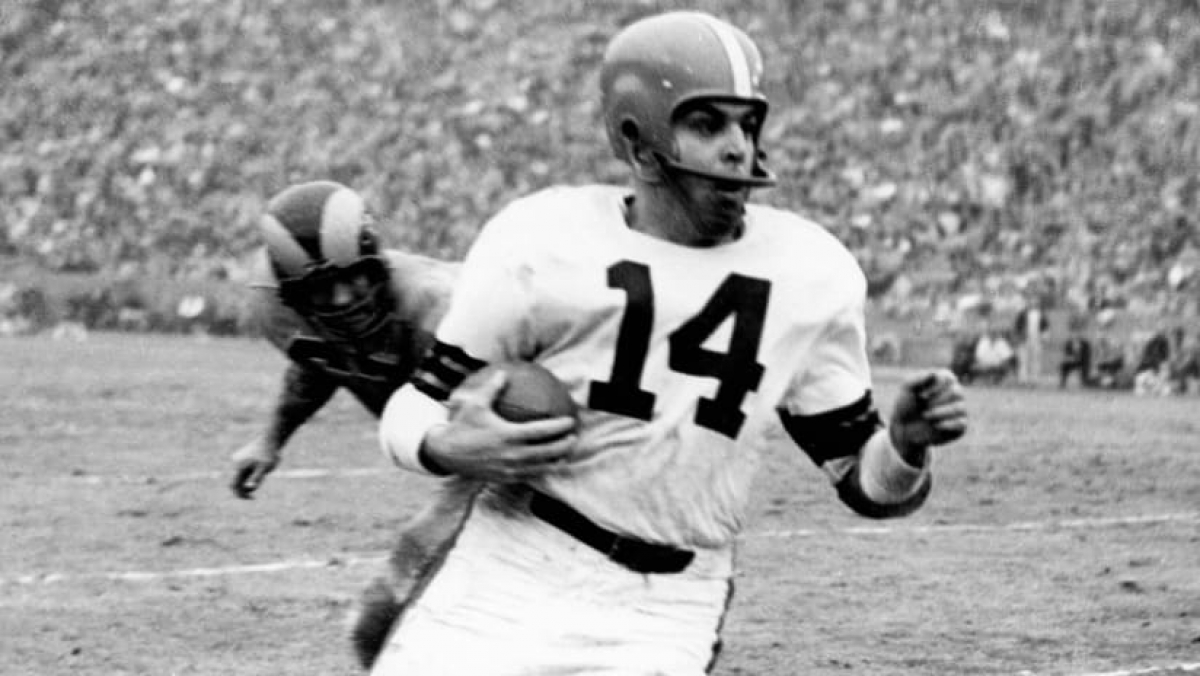
Long before Jim Brown arrived on Lake Erie, Otto Graham established the baseline of excellence for the Cleveland Browns. A multi-sport standout at Northwestern, Graham was named Big Ten Player of the Year in 1943 and finished third in Heisman Trophy voting. While enrolled in Navy flight school at Colgate, he continued to showcase his athletic versatility by playing professional basketball for the Rochester Royals—winning an NBL title in 1946—before legendary coach Paul Brown selected him to be the field general for his new pro football franchise in the All-America Football Conference (AAFC).
Graham possessed pinpoint passing accuracy, supreme poise under pressure, and a deep understanding of Paul Brown’s revolutionary, structured passing offense. Operating under center, "Automatic Otto" possessed a quick release, deadly deep-ball placement, and the mobility to run for clutch third-downs or short-yardage touchdowns. He set a standard for efficiency that fundamentally shifted professional football from a run-heavy league to a passing-dominated sport.
What truly defined Graham’s playing style was his ahead-of-his-time mastery of pocket mechanics and intermediate field vision. In an era when quarterbacks rarely had structured pass protection, Graham navigated collapsing pockets with light, rhythmic footwork, never taking his eyes off downfield coverage. He threw with exquisite touch, effortlessly dropping deep corner routes over tight coverage or driving fastballs into tight windows on comeback routes. His quick decision-making allowed Paul Brown’s scripted timing offense to operate with surgical precision, rarely giving pass rushers a chance to strike.
Graham's skills extended beyond his arm, as he brought a tough, gritty physicality to the quarterback role. With a background as a collegiate single-wing tailback, he served as a powerful goal-line runner, executing handoffs on bootlegs or sneaks into the end zone. A fearless leader, he embraced the rough physicality of 1950s football, often playing through severe injuries, and his steady, composed presence in fourth-quarter drives earned the complete trust of his teammates in the Cleveland huddle.
Since the franchise's inception in 1946, Graham transformed the AAFC into his personal domain. He led the Browns to win all four AAFC Championship Games (1946–1949) and topped the league in passing yards in the last three seasons before the league dissolved.
Throughout that four-year period, Graham was awarded three AAFC Most Valuable Player honors. Following the dissolution of the AAFC after the 1949 season and the subsequent merger of the Browns into the National Football League, critics anticipated that Cleveland’s expansive passing offense would falter against the seasoned defenses of the NFL.
Graham quickly silenced all skeptics in his 1950 NFL debut season. In the season opener against the reigning NFL champion Philadelphia Eagles—a game dubbed the "World Series of Football"—he shredded the Eagles for 346 passing yards and three touchdowns in a 35–10 rout. He capped the year by leading the Browns to the 1950 NFL Championship Game, throwing four touchdown passes and engineering a game-winning fourth-quarter drive in a 30–28 victory over the Los Angeles Rams, securing five consecutive league titles for Cleveland.
Over the subsequent three seasons, Graham remained the unequivocal benchmark at the quarterback position. He was awarded the UPI NFL Most Valuable Player accolade in 1951, guiding Cleveland to the championship game. In 1952, he led the NFL in completions with 181 and passing yards totaling 2,816. In 1953, he achieved a personal statistical zenith, earning his second NFL MVP award while leading the league in completion percentage (64.7%), passing yards (2,722), and attaining an impressive 10.55 yards per pass attempt.
Graham's career concluded with back-to-back championship masterclasses. In the 1954 NFL Championship Game, he delivered an all-time performance against the Detroit Lions, throwing for three touchdowns and rushing for three more in a 56–10 blowout win. Though he initially planned to retire, Paul Brown coaxed him back for one final season in 1955. Graham responded by earning his third NFL MVP award and leading the Browns back to the title game against the Rams, where he ran for two touchdowns and threw for two more in a 38–14 victory before walking off into retirement to a standing ovation.
Graham played in 126 regular-season games, compiling a staggering 105–17–4 record as a starter and leading the Browns to the league championship game in every season of his career. He threw for 23,584 yards and 174 touchdowns, adding 44 rushing touchdowns. His career average of 8.63 yards per pass attempt remains the highest mark in NFL history.
In 1965, Graham took his rightful place in Canton with his induction into the Pro Football Hall of Fame. The Browns retired his iconic No. 14 jersey, enshrined him in the inaugural class of the Cleveland Browns Ring of Honor in 2010, and commemorated his impact with a bronze statue outside Huntington Bank Field. He was also selected to the NFL 1950s All-Decade Team as well as the NFL's 75th and 100th Anniversary All-Time Teams.
Comments powered by CComment