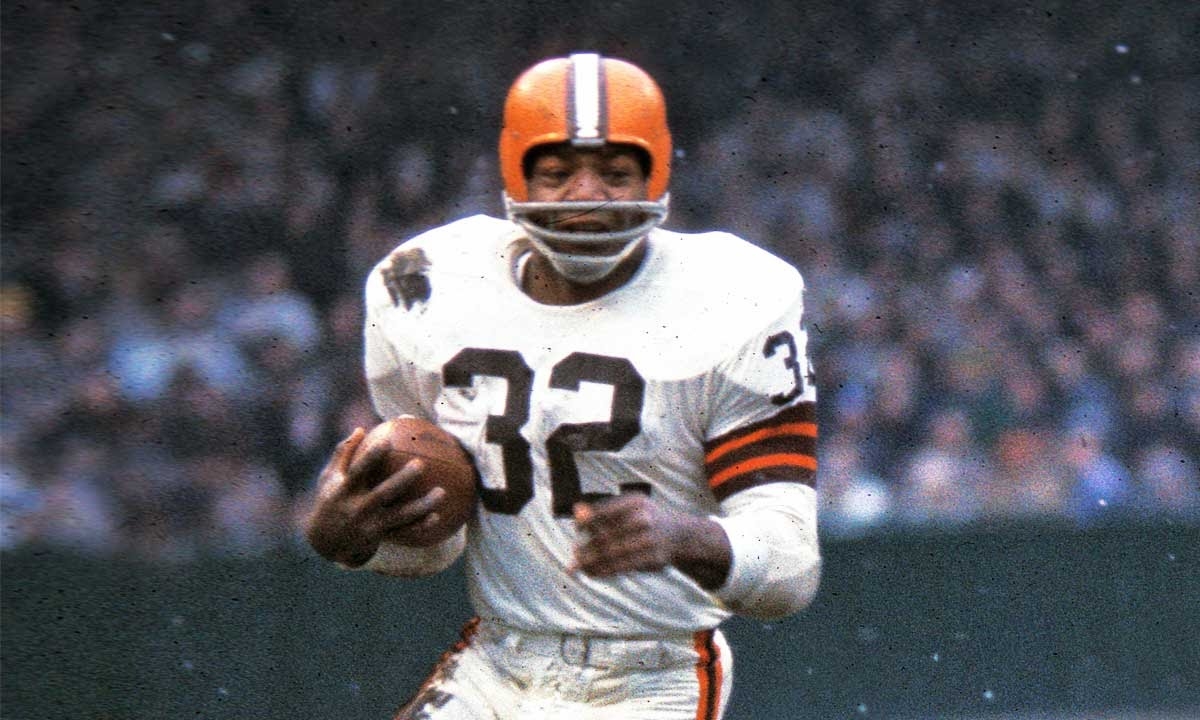
Jim Brown is a football god.
We could end it here, but out of deference to the man we think is not only the most outstanding rusher in the history of the game but the best offensive player ever, we will go through all the reasons why Jim Brown is the best player in franchise history, and arguably the greatest all-time player of any NFL franchise.
Before ever stepping foot on an NFL field, Jim Brown had already built a mythical reputation at Syracuse University as one of the greatest all-around collegiate athletes in American history. A dominant multi-sport phenom who starred in basketball and track and field and earned All-American honors in lacrosse, Brown’s primary playground remained the gridiron. His collegiate curtain call came in the 1957 Cotton Bowl, where he delivered a breathtaking 21-point performance against TCU—rushing for 132 yards, scoring three touchdowns, and kicking three extra points. Yet despite his overwhelming power, track-star speed, and peerless resume, five NFL teams somehow passed on him in the 1957 NFL Draft. Cleveland seized the opportunity at sixth overall, bringing an absolute force of nature to Lake Erie.
Sixth overall, and it was still a steal.
Brown was built like a modern edge rusher, yet he operated in a 1950s backfield. He possessed an extraordinary balance of crushing inner power and electric open-field speed. Rather than avoiding contact, Brown violently punished would-be tacklers with a legendary stiff-arm, leaving defenders dazed in his wake before pulling away into the secondary.
What truly set Brown’s playing style apart was his blend of supreme physical dominance and calculating tactical patience. He did not simply run over defenders; he probed defensive fronts with high-knee, gliding footwork before exploding through the hole at top speed. When contact came, Brown lowered his shoulders, drove through multiple defenders, and delivered a violent, stiff-arm that routinely knocked tacklers off their feet. Equally famous was his demeanor after the whistle: Brown was notorious for getting up from the turf in painful slow motion, dragging himself back to the huddle as if utterly exhausted, only to take the very next handoff and sprint 70 yards downfield past an already demoralized defense.
Brown made a remarkable rookie debut in 1957, quickly establishing himself in the league. He led the NFL with 942 rushing yards and nine touchdowns, earning both NFL Offensive Rookie of the Year and AP NFL MVP awards early in his career while guiding Cleveland to the NFL Championship Game. His standout moment came on November 24 against the Los Angeles Rams, when he broke the single-game rushing record with 237 yards and four touchdowns. This record remained unbroken for 14 years.
Entering his second season in 1958, expectations were extremely high, but Brown exceeded all of them. In only 12 games, he broke the NFL single-season rushing record with 1,527 yards and scored a personal best of 17 rushing touchdowns. He averaged an impressive 127.3 yards per game and 5.9 yards per carry, earning his second straight MVP award and cementing his position as the most dominant athlete in team sports.
Throughout three seasons, the league consistently sought strategies to limit number 32. Brown earned three straight rushing titles, with 1,329 yards in 1959, 1,257 yards in 1960, and 1,408 yards in 1961. Night after night, defensive coordinators would pack the box with eight or nine players, yet Brown consistently broke through the line, forcing defenders past it.
The only season Brown did not win the league rushing title was 1962, but he still displayed his versatile excellence. He finished second in rushing with 996 yards and significantly contributed to the passing game, setting personal records with 47 receptions for 517 yards and five touchdowns. That year, he amassed over 1,500 yards from scrimmage, proving he was equally dangerous in space as he was between the tackles.
Brown reached a legendary peak in 1963, putting together what remains one of the greatest rushing campaigns ever put on tape. He shredded opposing fronts for a mind-boggling 1,863 rushing yards and 12 touchdowns across 14 games, averaging an incredible 6.4 yards per carry. That historic campaign broke his own single-season record and established a new gold standard for backfield dominance that endured for a decade.
Brown’s team achievements peaked in 1964 when he led the league with 1,446 rushing yards and scored seven touchdowns. He played a key role in Cleveland's dynamic offense, which advanced to the championship game. In the 1964 NFL Championship facing the strong Baltimore Colts, Brown gained 114 yards on 27 carries, helping Cleveland secure a historic 27–0 shutout victory and claim the title for Ohio.
In 1965, Brown delivered a final masterclass that marked the pinnacle of his legendary career. He amassed 1,544 rushing yards and topped the league with 21 total touchdowns (17 rushing, 4 receiving), guiding Cleveland to yet another NFL Championship Game. For his outstanding performance, Brown was awarded his third AP NFL MVP title, ending his career at the peak of his athletic abilities.
At just 29 years old and coming off an MVP season, Brown shocked the sports world during the summer of 1966 by announcing his retirement from professional football while on the set of The Dirty Dozen. He left the game with 12,313 career rushing yards and 106 rushing touchdowns, holding every major career ground record by a massive margin. While other legends have since passed his total yardage marks, none matched his blistering pace or his career average of 104.3 rushing yards per game.
The sheer efficiency of Brown’s career remains unmatched. Across 118 regular-season games, he accumulated a career Approximate Value (AV) of 122—an astonishing figure considering AV was not retroactively calculated for his first three seasons (1957–1959), meaning that 122 AV was produced across just 82 recorded games.
He played nine seasons in the NFL, earned nine Pro Bowl selections, won eight rushing titles, and was named a First-Team All-Pro eight times. In nine years, he never missed a single game. Brown entered the Pro Football Hall of Fame in 1971 and was named to the 1960s All-Decade Team and the 50th-, 75th-, and 100th-Anniversary Teams. Brown's number 32 was retired by the team, and he was named to their Ring of Honor as part of the first group in 2010.
We will finish with one word…
Legend.


Comments powered by CComment