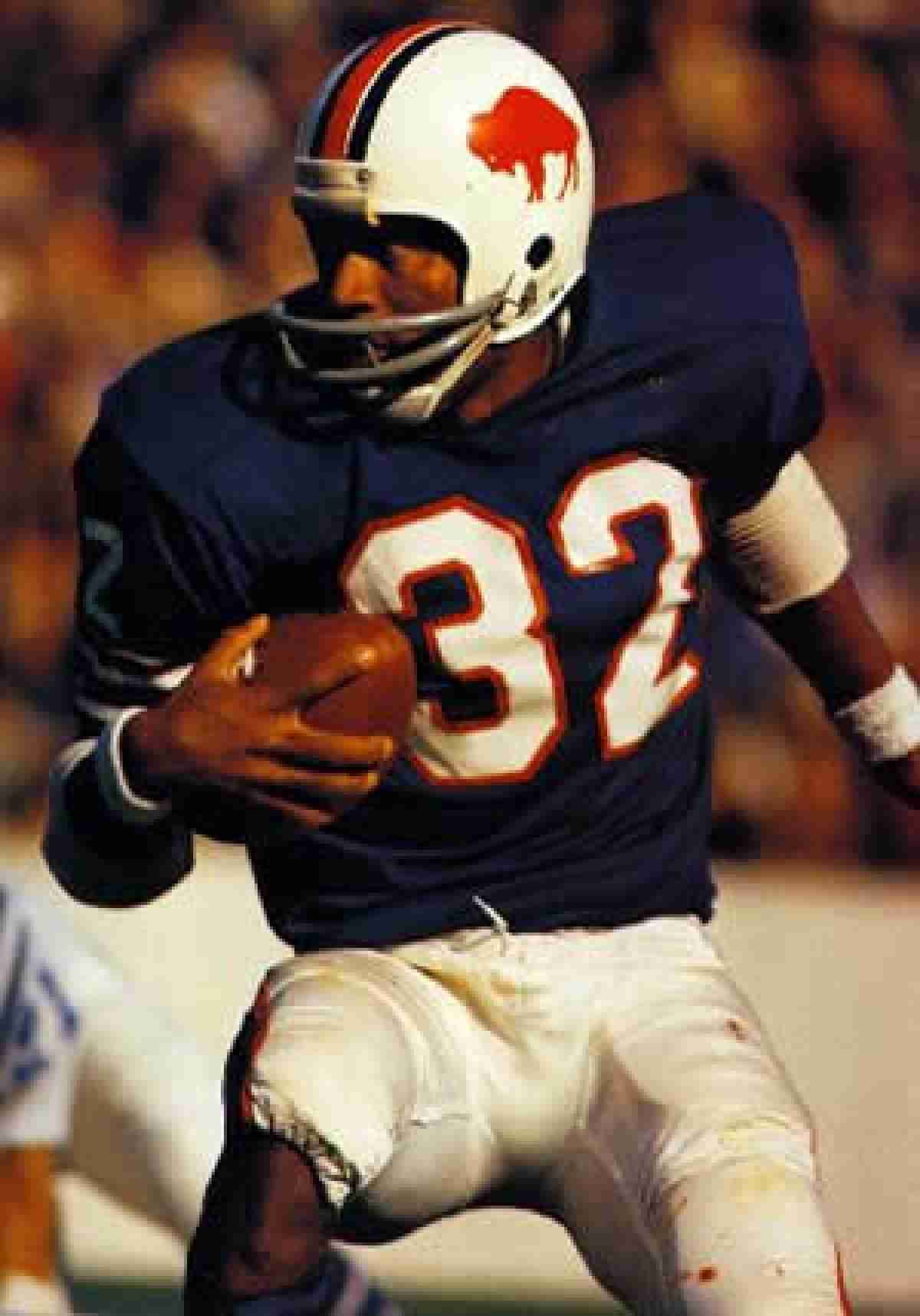
Drafted first overall in the 1969 AFL-NFL Draft from USC after winning the Heisman Trophy, Orenthal James Simpson joined Buffalo amid huge expectations as one of the most highly touted college prospects in football history. His early career was limited by head coach John Rauch's mismanagement of his skills, resulting in modest stats during his first three seasons. Everything changed in 1972 with the arrival of head coach Lou Saban and the formation of the "Electric Company,” a powerful offensive line featuring guards Joe DeLamielleure and Reggie McKenzie. With a strong blocking unit, Simpson was able to run freely, leading to five seasons of remarkable individual rushing success.
Simpson blended exceptional track sprinting speed with impressive lateral agility. From deep I-formation formations, he used sharp vision to analyze blocking schemes at the line, reaching top speed in just two strides. After turning the corner, Simpson was nearly impossible to catch in open space, often employing a stiff-arm to fend off defenders while sprinting down the sideline.
His legendary 1973 season marked his greatest achievement. In only 14 games, Simpson made history as the first NFL player to surpass 2,000 rushing yards, tallying 2,003 yards and 12 touchdowns with an impressive average of 143.1 yards per game. This single-season league record remains unbroken. He also claimed all major awards, including AP NFL MVP, Offensive Player of the Year, and the Bert Bell Award. It remains one of the most impressive offensive campaigns in NFL history.
"The Juice" maintained his reputation as the premier running back over the next three seasons. In 1975, he led the league with 1,817 rushing yards and scored 23 total touchdowns (16 rushing, 7 receiving). The following year, he secured his fourth rushing title with 1,503 yards, highlighted by a famous 273-yard game against Detroit on Thanksgiving Day. From 1972 to 1976, Simpson earned five straight First-Team All-Pro selections and appeared in five Pro Bowls, despite leading a struggling Buffalo team.
After a shoulder injury ended his 1977 season early, Simpson was traded to the San Francisco 49ers, where he played two more seasons before retiring in 1979. During nine seasons with Buffalo, he rushed for 10,183 yards and scored 57 touchdowns, accumulating a total of 12,425 yards from scrimmage. He was honored as a member of the NFL 1970s All-Decade Team and the NFL 100th Anniversary All-Time Team. In 1980, Simpson became the inaugural member of the Buffalo Bills Wall of Fame, becoming the first individual enshrined on the stadium's ring. Five years later, he entered the Pro Football Hall of Fame in 1985.
Simpson’s legacy is complex. In June 1994, his ex-wife Nicole Brown Simpson and her friend Ronald Goldman were tragically murdered outside her Los Angeles residence. Simpson was later arrested after a televised low-speed chase in his white Ford Bronco, an event that became known as the "Trial of the Century.”
The Bills did not remove Simpson from the Wall of Fame, but when the team relocated to Highmark Stadium, they announced that he would no longer be included in the display.


Comments powered by CComment