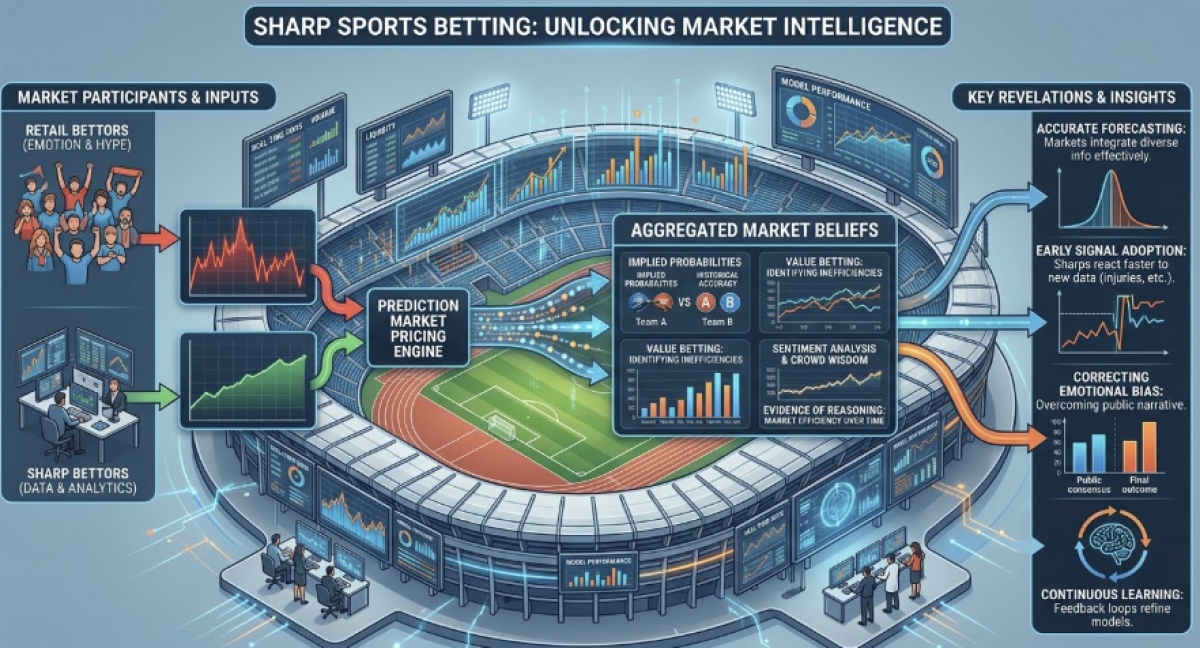
For decades, the sports debate ran on gut feeling. Barstool arguments, call-in radio and comment sections were full of confident takes, but almost nobody kept score on who was actually right. That is changing. Prediction markets such as Kalshi and Polymarket now let thousands of people put real money behind their views on NFL games, MLB playoff series, Champions League nights and even esports finals. The prices on those markets move every few seconds, and the people trading them leave a public record of every call they make.
That record turns out to be one of the most interesting data sets in sports today. When you can see which traders have consistently read games well over hundreds of matches, you stop listening to the loudest voice and start paying attention to the most accurate one.
Why market prices beat hot takes
A betting line is set by a bookmaker who wants balanced action. A prediction market price is different: it is the crowd's live estimate of a probability. If a team is trading at 62 cents to win, the market collectively thinks it wins about 62 percent of the time. When an injury report drops or a starting pitcher is scratched, that number moves within minutes. Watching a market chart during a game is a little like watching the crowd's confidence rise and fall in real time.
This makes prediction markets a useful lens even for fans who never place a trade. A sudden swing tells you that something meaningful happened, often before the broadcast crew catches up. A price that refuses to move despite a lot of noise on social media tells you the public panic may be overdone.
Following the people who are actually good
The more interesting question is not what the market thinks, but who inside the market keeps getting it right. Most traders are roughly break-even over time. A small group consistently finds value, especially in less crowded leagues and in esports, where public information is thinner and specialists have a real edge.
Tracking those traders used to require digging through raw transaction histories. Free tools now do that work. Sites like Tips pull public trading activity from Kalshi and Polymarket, filter out the noise, and show which predictors have a strong record league by league. You can see what a proven trader picked tonight, how much they put behind it and how their record looks over the last 30 days. For esports in particular, the site collects live picks and post-match fan reaction for leagues like the LoL World Championship, VCT and CS2 majors, which is useful if you follow those scenes but do not have time to watch every map. You can browse those esports predictions here.
A healthier way to argue about sports
None of this replaces the fun of having your own opinion. What it does is add accountability. When the debate is "who was right last month," a public track record settles it quickly. It also pushes fans to think in probabilities instead of certainties. A 60/40 game is not a lock, and the best traders are comfortable being wrong four times out of ten as long as their reads are priced correctly.
For readers of a site that celebrates careers built over many seasons, that idea should feel familiar. Greatness in sports is measured over a long body of work, not a single highlight. The same is true for predictions: one lucky call means very little, but a strong record over hundreds of games tells you something real.
Prediction markets are still young, and regulation varies by country, so it is worth checking the rules where you live before trading. But as a source of information, the data they produce is already changing how informed fans read a matchup. Next time a big game is coming up, look at what the market is saying and who the consistently accurate traders are backing. You may find it sharpens your own take more than another round of hot takes ever could.
Comments powered by CComment