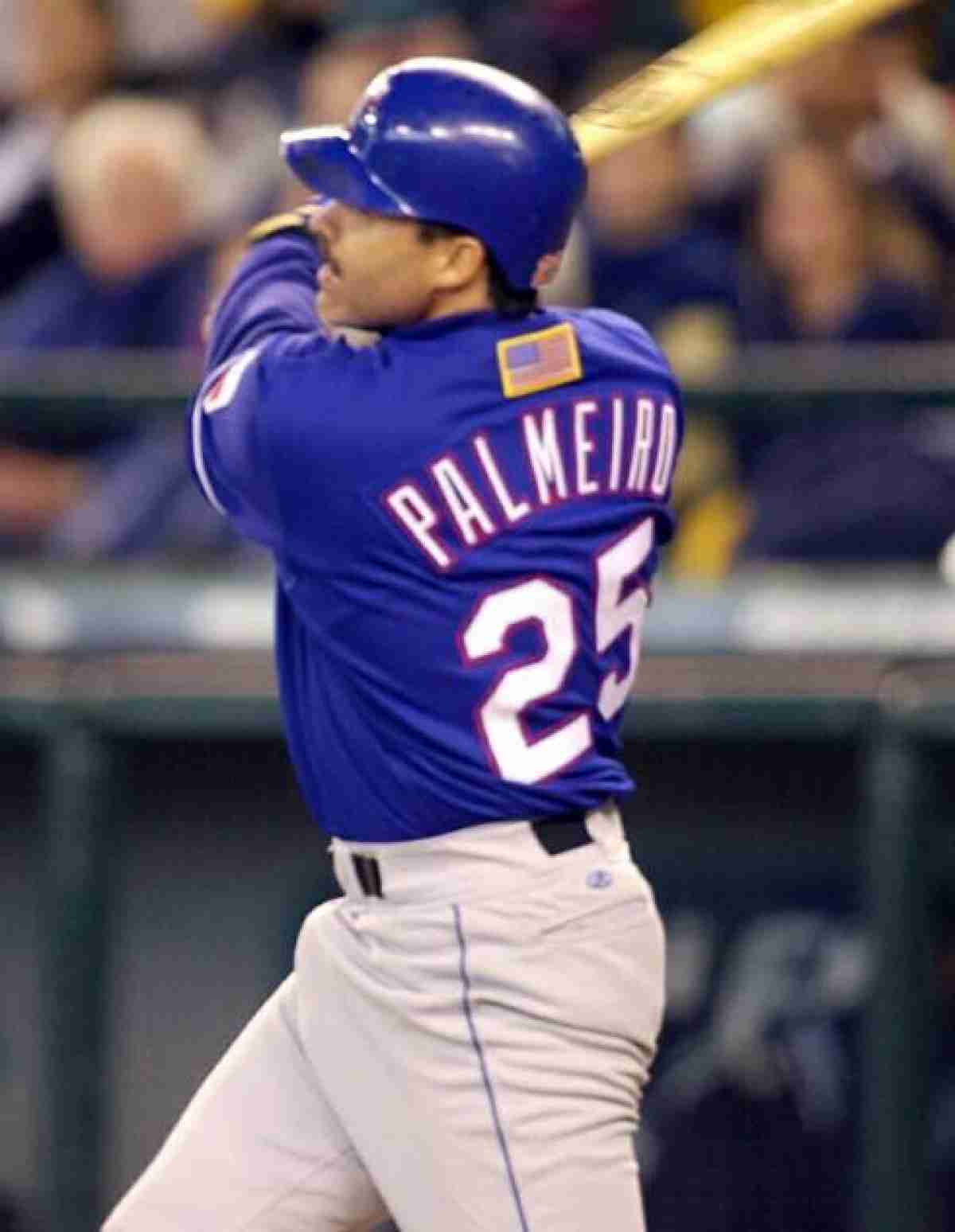
When assessing the purely mechanical precision of a left-handed swing, very few hitters in the modern expansion era have matched the metronomic, smooth-operating consistency of the Cuban-born first baseman. Rafael Palmeiro was never a flamboyant or eccentric figure on the field; instead, he approached the act of producing high-caliber offensive output as a mandatory routine. Throughout two distinct, highly productive multi-year periods in Arlington, the exceptionally durable slugger quietly compiled some of the most remarkable, volume-rich statistics in the franchise's history. However, while his performance at the plate clearly demonstrates elite, mid-lineup capability, his legacy remains disconnected from the sport’s formal honors—traumatized by a sudden, late-career decline that permanently reshaped his standing in the historical record.
His arrival before 1989 was the result of an exciting, big trade with the Chicago Cubs that brought fresh energy and a talented group to Texas. Palmeiro made consistently powerful contact a daily habit, quickly becoming a standout player in the American League. In 1990, he passionately took on junior circuit pitching, leading the major leagues with 191 hits and achieving an impressive .319 batting average.
He substantiated this assertion during a remarkable 1991 All-Star campaign, leading the league with 49 doubles, while accumulating 203 hits and hitting 26 home runs. His career progression peaked notably in the 1993 season when he hit a career-high 37 home runs and led the league with 124 runs scored, thereby establishing himself as one of the premier positional assets nationwide.
Following the conclusion of that remarkable 1993 campaign, a highly publicized and progressively contentious contractual dispute arose between Palmeiro's representatives and the Texas front office concerning his long-term market valuation. Rather than offering a lucrative extension to their domestic star, the management made a decisive strategic shift that winter, allowing him to depart in free agency and sign with Baltimore. Concurrently, Texas replaced him at first base by signing Will Clark.
The move significantly heightened Palmeiro's determination, leading to five exceptional years on the East Coast. However, the appeal of Arlington remained irresistible, prompting a substantial five-year contract upon his return through free agency prior to the 1999 regular season. This second stint was when his innate physical strength truly reached its peak.
In 1999, Palmeiro delivered an exemplary offensive performance, recording a career-high 47 home runs and generating 148 runs batted in. His impressive slash line of .324/.420/630 earned him a Silver Slugger Award and a commendable fifth-place finish in the Most Valuable Player (MVP) voting. Notably, he also received a Gold Glove Award that summer, despite participating in only 128 games as the designated hitter and 28 games at first base. Had he been positioned as an outfielder demonstrating comparable offensive productivity, rather than occupying the constricted roles of first baseman and designated hitter, his record would likely have included double the number of All-Star selections, totaling eight.
He sustained that thunderous output with consecutive 43-homer, 39-homer, and 38-homer campaigns, maintaining a relentless pace through the conclusion of his second Texas departure in 2003. Across his 1,573 games with the Rangers, he accumulated exactly 1,692 hits, 321 home runs, 335 doubles, and 1,039 runs batted in, all backed by an exceptional .290 batting average and a lethal .519 slugging percentage. Advanced analytics strongly reinforce the sheer density of his localized peak, anchoring his magnificent footprint with a spectacular 44.6 franchise position bWAR—a total that ranks among the absolute highest in club history.
Naturally, the broader historical narrative faces a massive, legacy-tarnishing controversy. Following a return to the Orioles late in his active journey, where he joined the ultra-exclusive 3,000-hit and 500-home run clubs, Palmeiro notoriously wagged his finger at a congressional hearing while denying performance-enhancing drug use, only to test positive for stanozolol just months later. The severe fallout completely crushed his public image, resulting in a strict, permanent exclusion from both the National Baseball Hall of Fame and the official Texas Rangers Hall of Fame.
Comments powered by CComment