
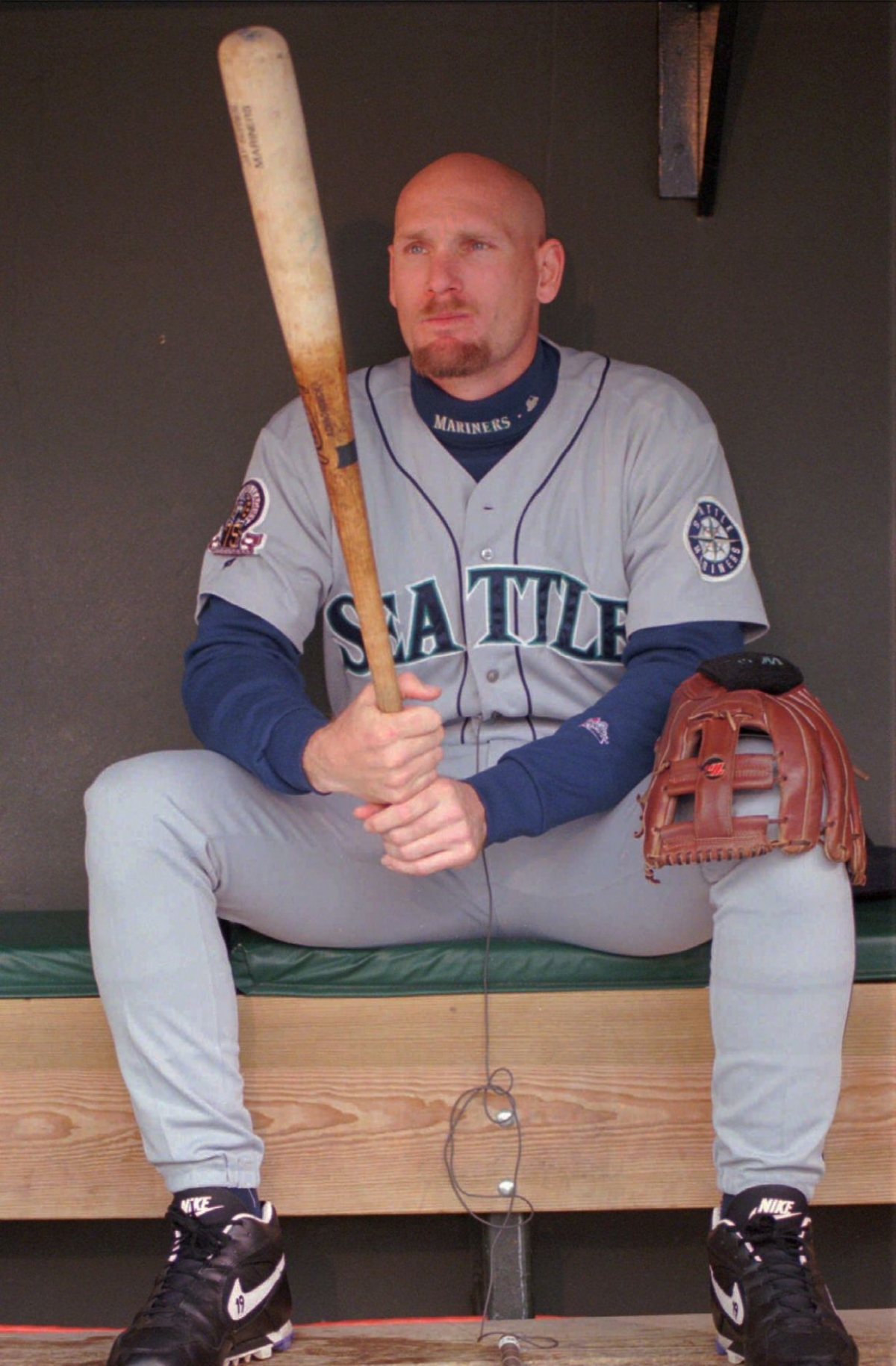


When learning that his son (erroneously) was dead from George Steinbrenner, Frank Costanza’s first response on Seinfeld was:
“What the hell did you trade Jay Buhner for? He had 30 Home Runs, over 100 RBIs last year! He’s got a rocket for an arm! You don’t know what the hell you’re doing!”
How could we not open with this?
Frank Costanza was entirely right. The infamous July 1988 trade that sent Jay Campbell Buhner from the Bronx to the Pacific Northwest in exchange for Ken Phelps—who was out of baseball just two years later—stands as one of the most lopsided structural blunders in modern baseball history. Arriving in Seattle with a fierce, unadulterated competitive edge, the man affectionately known as "Bone" completely transformed his professional identity. Across a celebrated 14-year residency, the charismatic slugger became the raw, emotional heartbeat, the ultimate clubhouse enforcer, and the definitive power anchor of the most iconic era in franchise lore.
His initial period in Seattle did not produce immediate, rapid muscle growth, as he adapted to the demands of major league pitching on a daily basis. The pivotal breakthrough occurred in the 1991 season, when he surpassed the 20-home-run mark for the first time. Buhner consistently engaged in deep counts, turning this approach into a disciplined daily routine, and maintained or exceeded the 20-homer threshold for four consecutive summers. During this time, he established himself as an essential protective presence in the batting lineup for a young Ken Griffey Jr.
The peak of his hardware-certified legacy in evolution unfolded over an impressive three-year period from 1995 to 1997. He systematically dismantled American League pitching during the historic 1995 regular season, hitting 40 home runs and producing 121 RBIs with a commendable .566 slugging percentage, thereby securing a remarkable fifth-place position in the American League Most Valuable Player voting.
He carried that high-leverage devastation directly into the 1995 postseason, smashing another four home runs during the club's legendary "Refuse to Lose" playoff run that saved baseball in Seattle. He followed that up by unleashing even greater raw power during the 1996 schedule, hammering a career-high 44 home runs and driving in a monster 138 runs, before launching another 40 long balls with 109 RBIs in 1997.
The primary area where Buhner encountered substantial challenges under rigorous analytical scrutiny was his high-volume volatility. He was an extraordinarily effortful hitter who twice led the American League in strikeouts, returning to the dugout a remarkable 1,406 times while playing for the Mariners. Defensively, although Frank Costanza was entirely correct regarding his exceptionally strong throwing arm, Buhner displayed limited speed and lateral agility, frequently recording a defensive bWAR with negative values. Notably, during the summer of 1996, when he received his sole Gold Glove Award, he concluded that season with a -0.7 dWAR, demonstrating that his renowned throwing ability often concealed his underlying defensive metrics.
Trying to measure Buhner's legacy only through cold analysis really overlooks why he's such a beloved figure in our local culture. With his iconic shaved head and goatee—a look that was pretty unique in the sport back then—he shared a genuine, mutual love with the fans. The front office beautifully tapped into this natural fan enthusiasm by creating "Buhner Buzz Cut Night," a popular event where thousands of fans got free tickets to the Kingdome just for letting team barbers shave their heads—highlighting the strong connection between him and the community.
Following a series of severe hamstring and knee ailments late in his career, a definitive exit arrived when Buhner retired at the conclusion of the historic 104-win 2001 regular season. He departed from the field, leaving behind a formidable statistical legacy predominantly concentrated in the upper-left region of the map: a robust .494 slugging percentage, 951 hits, and exactly 307 home runs—a total that still ranks third in franchise history behind only Griffey and Edgar Martínez. Buhner retired in 2001, having amassed notable statistics including 307 home runs and a .497 slugging percentage. The Mariners honored the esteemed player by inducting him into their Hall of Fame in 2004.

Comments powered by CComment