
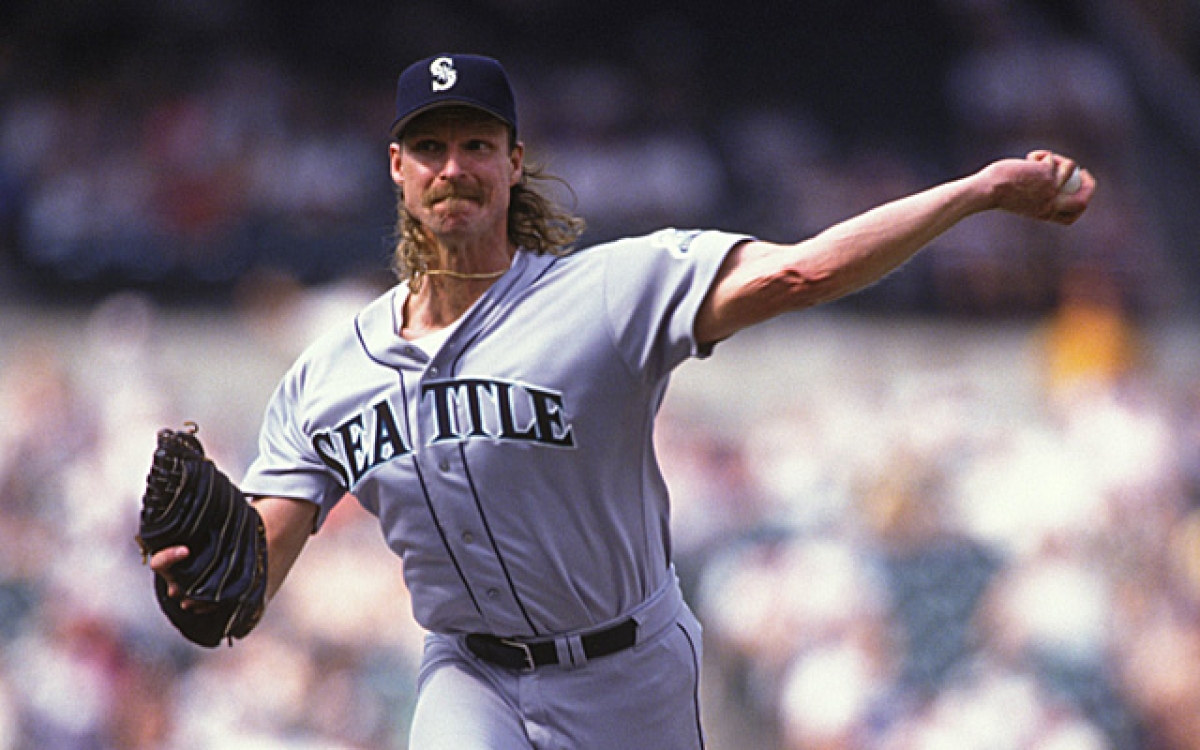
The Montreal Expos made what turned out to be a monumentally shortsighted decision when they traded a raw, erratic, 6-foot-10 left-hander to the Seattle Mariners early in the 1989 season. Randy Johnson was a literal and figurative giant on the mound, but his early years in the Pacific Northwest were defined by a frustrating paradox: an unhittable fastball paired with a complete lack of mechanical control. The "Big Unit" possessed an intimidating, low-three-quarters release point that terrified left-handed hitters, but he spent his first few seasons continuously fighting his own massive frame to find the strike zone.
His first full summer in Seattle in 1990 provided an immediate glimpse of this volatile baseline, as he earned All-Star selection and won 14 games with 194 strikeouts while leading the American League with 120 walks.
The pattern intensified over the subsequent two years. Johnson accumulated 228 strikeouts in 1991 and 241 in 1992; however, his inconsistent mechanics led to a significant number of free passes, totaling 152 and 144, respectively. Nevertheless, the 1992 season represented a pivotal moment; despite issuing walks, he secured his first American League strikeout title, beginning a formidable four-year dominance atop the leaderboard.
The legendary trajectory of his career was altered permanently in late 1992, thanks to a legendary dugout intervention by fellow power-pitcher Nolan Ryan and Mariners pitching coach Tom House. Ryan suggested a slight mechanical adjustment to Johnson’s landing foot to align his body toward home plate. The results were instantaneous and dramatic. By the spring of 1993, the Big Unit had harnessed his high-velocity arsenal. He emerged as a terrifyingly efficient frontline ace, winning 19 games and becoming the first Mariner to eclipse the 300-strikeout milestone with a spectacular 308 punchouts.
His newfound command culminated in a historic, award-winning 1995 campaign that carried the Mariners into the national spotlight. Johnson secured his first career American League Cy Young Award by orchestrating an incredible 18–2 record, pacing the league with a microscopic 2.48 ERA. His advanced efficiency metrics were entirely unrivaled; he dominated the league with a 1.045 WHIP and a 2.08 FIP, culminating in a legendary, heroic relief appearance in Game 5 of the American League Division Series against the Yankees to secure Seattle’s first postseason series victory.
While a severe back injury sidelined him for most of 1996, he rebounded with a magnificent 1997 showcase, winning 20 games with 291 strikeouts to anchor another postseason berth. However, by the summer of 1998, with free agency looming and relations with ownership souring, his performance temporarily dipped. Recognizing an impending career exit, the front office traded its iconic ace to the Houston Astros at the July deadline.
If there is a criticism of Johnson as a Mariner, it was that he was 0-6 for Seattle in the playoffs. While it is not relevant here, he did shake his post-season demons with the Arizona Diamondbacks in 2001.
Johnson was inducted into the Baseball Hall of Fame in 2015, three years after the Mariners selected him to their Hall of Fame.

Comments powered by CComment