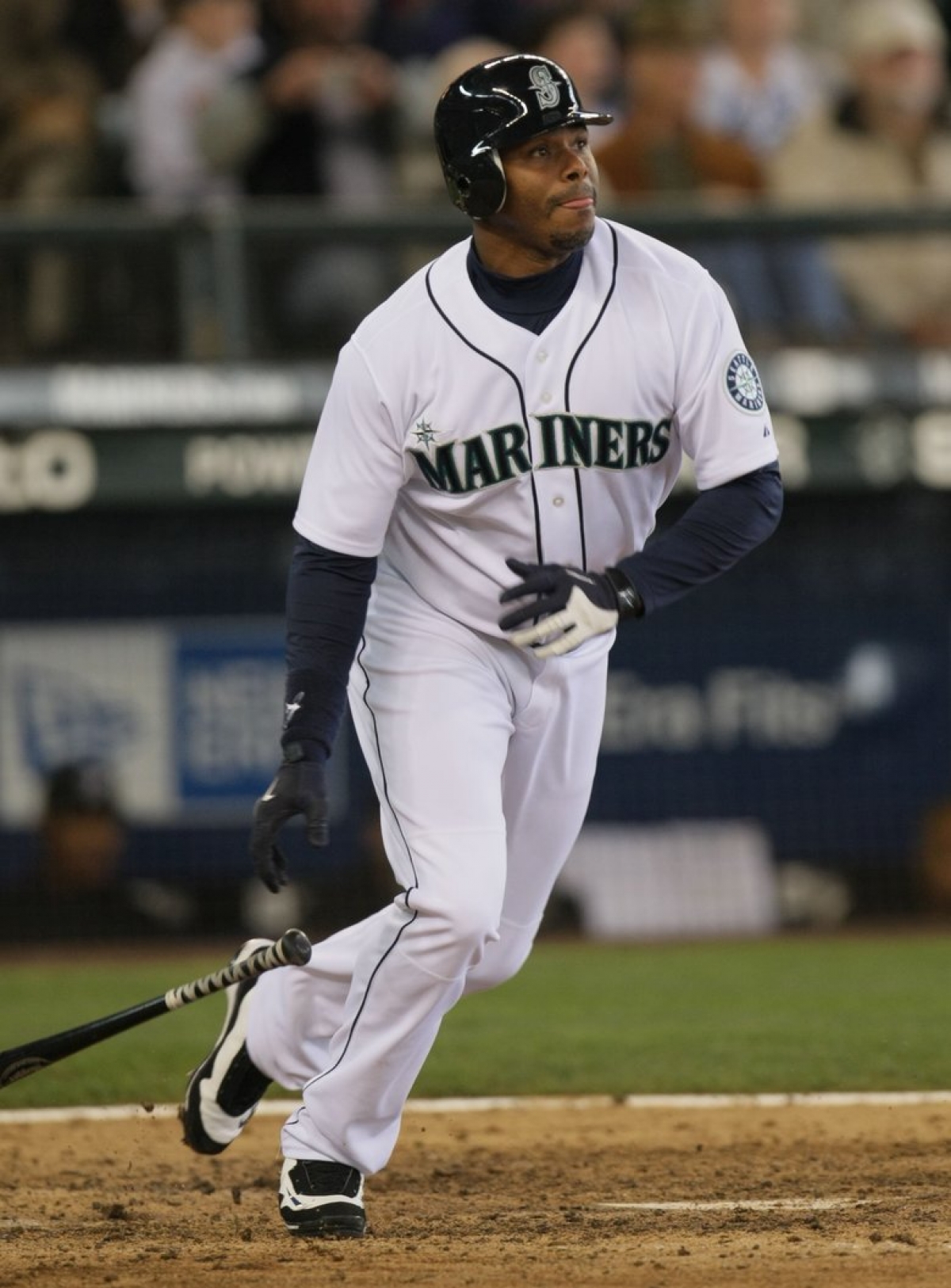
Examining the history of the Seattle Mariners often sparks debate around a trio of legendary figures who shaped different baseball eras in the Pacific Northwest. While Edgar Martinez's consistent drive and Ichiro Suzuki's groundbreaking global influence are notable, the ultimate pinnacle of individual achievement points to one undisputed leader. Ken Griffey Jr. was more than just a Mariners player; he was instrumental in revitalizing baseball in Seattle. As the son of three-time All-Star Ken Griffey Sr., "The Kid" was naturally groomed for greatness, blending a natural talent with a charismatic, backward-cap flair that made the Pacific Northwest a hub of youth culture. With what is arguably the most elegant and fluid left-handed swing in the sport, Griffey was selected first overall in 1987 and made his MLB debut at 19 in 1989. His initial season saw a promising 16 home runs, but it was only the beginning of a decade of nationwide dominance.
The 1990s were dominated by Ken Griffey Jr. During that decade, he transformed the expansive Kingdome into his own stage, earning an All-Star selection each summer. He exemplified the five-tool player.
As a pure hitter, his bat control and spatial awareness led him to surpass the coveted .300 batting average seven times during his time with Seattle. As a power hitter, he consistently overwhelmed American League pitching staffs, winning four home run titles and recording six seasons with at least 40 home runs.
His exceptional run production was extraordinary; he achieved seven 100-RBI seasons, including a renowned four-year period from 1996 to 1999 where he never had fewer than 134 RBIs each season. This consistent offensive performance earned him seven Silver Slugger Awards and made him the most recognizable and universally loved athlete worldwide.
His ultimate evolutionary peak occurred during a stunning 1997 regular season. Griffey showcased pure dominance, leading the majors with 125 runs, 56 home runs, and 147 RBIs, while hitting an impressive .646 slugging percentage, earning him the American League Most Valuable Player Award unanimously. His relentless, high-velocity playmaking carried the Mariners to a division title, and his internal excellence was so consistent that he secured six additional top-ten finishes in the AL MVP balloting over his residency.
However, concentrating solely on his offensive output only tells part of the story. In center field, Griffey transformed defensive play with his exceptional closing speed and a fearless approach to his safety, often leaping over concrete walls to prevent home runs. His defensive skill earned him 10 straight Gold Glove Awards from 1990 to 1999, solidifying his reputation as a versatile and outstanding player.
Furthermore, his high-velocity instincts made him a formidable threat on the basepaths, swiping 167 bases in a Mariners uniform and executing the single most meaningful run in franchise history, sliding across home plate to score from first on Edgar Martinez's "The Double" in Game 5 of the 1995 ALDS.
However, all historical eras eventually reach a definitive career end. Prior to the 2000 campaign, desiring to play closer to his family's hometown, Griffey requested a change of scenery. The front office engineered a landscape-shifting trade to the Cincinnati Reds, and while the Mariners received a package that lacked a superstar of his singular magnitude, Griffey’s physical tools began to undergo an accelerated, injury-hampered decline away from the evergreen state.
He ultimately returned to his true baseball home in 2009, logging two sentimental final seasons in Seattle before executing a quiet walk away from the game in the summer of 2010
You can look at others like Ichiro Suzuki or Edgar Martinez for this top spot, and we did. However, when it was all said and done, nobody on this team was this great for this long. As of this writing, Ken Griffey Jr. is the all-time franchise leader in bWAR (70.6) and Home Runs (417), and he owns a Slash Line of .292/.374/.553.
The Mariners inducted Griffey Jr. into their franchise Hall of Fame in 2013, and three years later, the team retired his number 24. He was also inducted into the Baseball Hall of Fame on his first try that same year.
Comments powered by CComment