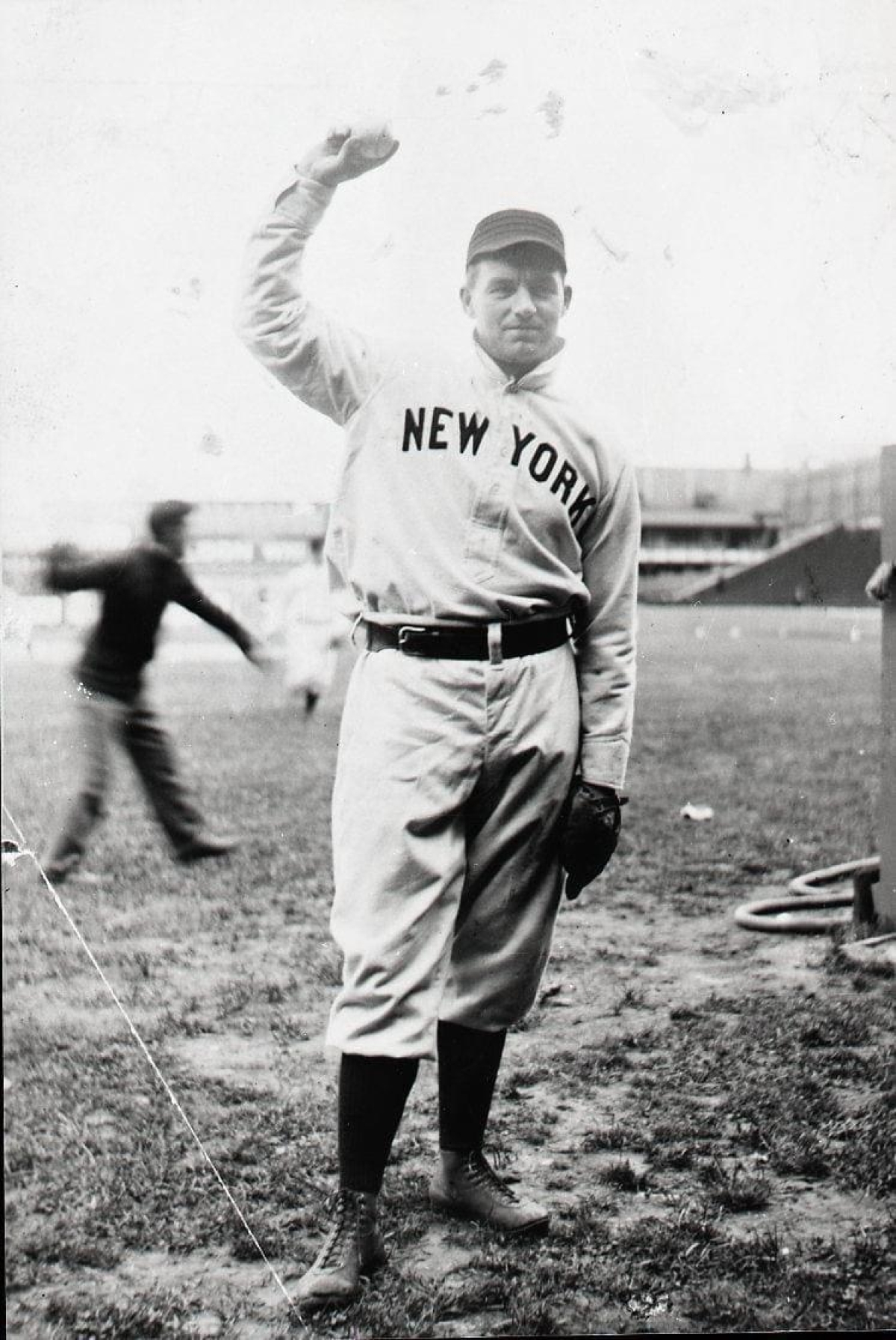
Joe McGinnity originally earned his immortal moniker, "Iron Man," because he worked in a heavy iron foundry during the winter months in Oklahoma. Yet once he followed his close ally and manager John McGraw from the collapsing American League Baltimore Orioles to Manhattan in July 1902, that nickname became the ultimate description of absolute, unadulterated physical endurance. While he spent his entire New York residency sharing the marquee with the elegant, high-profile Christy Mathewson, the stocky right-hander built a hardware-certified legacy of raw work volume that remains completely unmatched in the history of human anatomy.
His debut in 1903 as a regular in the New York rotation quickly established his remarkable durability. McGinnity made it a personal rule to take the mound under any conditions. He relied on a heavy, underhand-slanted "submariner" pitch that produced many ground balls and minimized shoulder strain. That summer, he set an unbreakable senior circuit record by pitching an astonishing 434.0 innings in 55 appearances, leading the league with 31 wins. Most famously, in August, he demonstrated extraordinary stamina by pitching—and winning—both games of a doubleheader three separate times in one month.
Far from an isolated incident in his career, he commendably substantiated this through constructing an exemplary regular-season performance in 1904. McGinnity demonstrated he was considerably more than a mere accumulator, providing an unambiguous demonstration of his skill in run prevention. He led the senior circuit with an outstanding, career-best 35 victories, a remarkable 0.96 WHIP, and nine shutouts, while earning the National League ERA title with an impressive 1.61 earned run average across 408.0 innings. Advanced efficiency metrics further corroborate the exceptional quality of this peak; he led the entire major leagues with an excellent 9.7 pitching bWAR, playing a pivotal role in the Giants' consecutive pennants and setting the foundation for their historic 1905 World Series victory over Philadelphia — during which he delivered a masterful, five-hit complete-game shutout in Game 4, instrumental in securing the world championship.
Assessing his profile within a comprehensive algorithmic review necessitates recognizing the abrupt and imbalanced decline in performance that ultimately brought his major league career to an end. McGinnity distinguished himself by leading the league in games pitched for five consecutive summers (1903–1907), yet the substantial and high-stakes workload ultimately resulted in a significant physical turning point. His efficiency started to diminish during the 1907 season, and his availability drastically declined in 1908 following a severe and debilitating fever that severely undermined his physical capabilities.
Recognizing a natural parting of the ways, the 37-year-old made a definitive business exit after the 1908 schedule, leaving the major leagues to become a minor-league owner, manager, and active pitcher—continuing to throw in the bush leagues well into his 50s.
McGinnity left the Polo Grounds with a remarkable record of 151–88, 255 complete games, and a stellar 2.38 ERA over seven seasons representing New York. The Old Timers Committee selected McGinnity for the Baseball Hall of Fame in 1946.
Comments powered by CComment