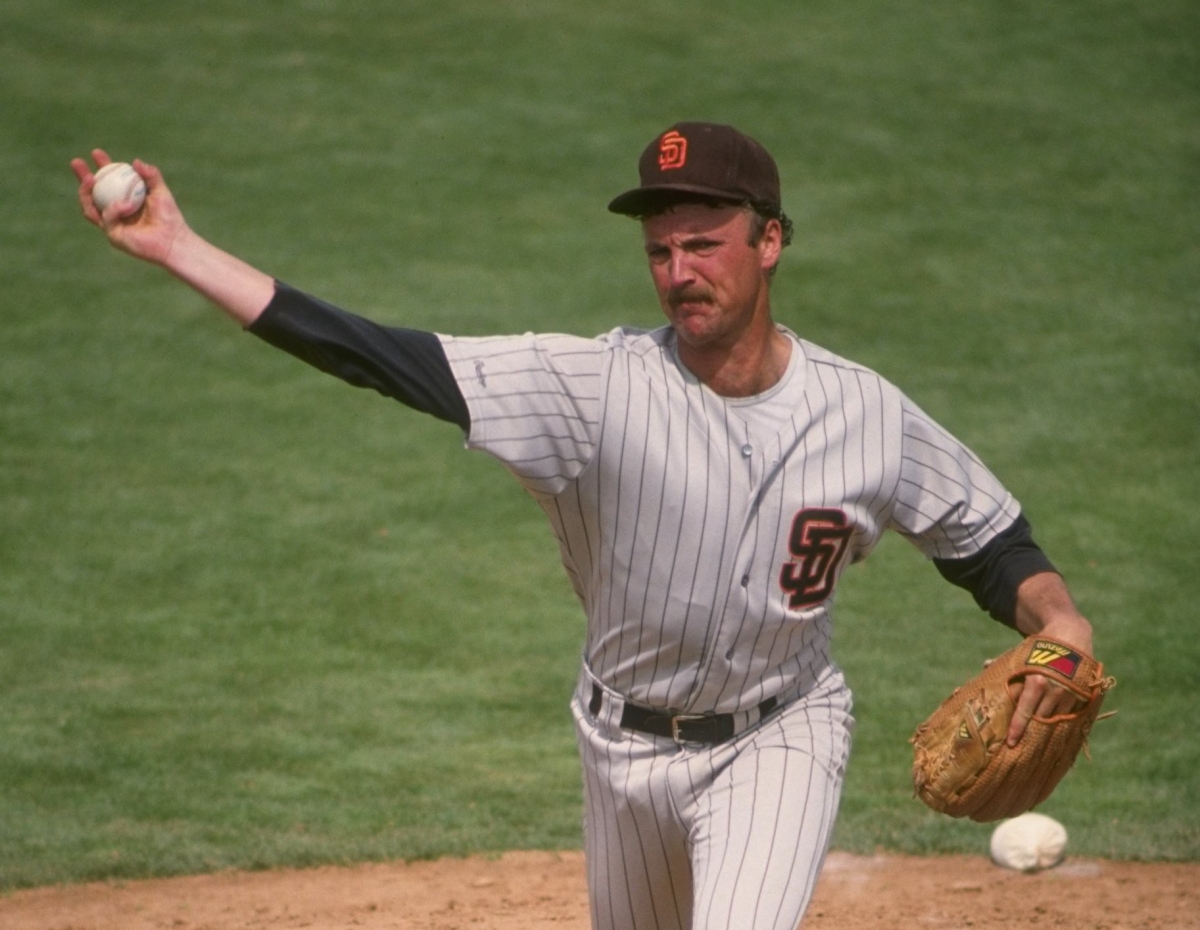
Few pitchers in baseball history have experienced a more divided relationship with two fan bases than Ed Whitson. To the Bleacher Creatures in New York, he symbolizes a turbulent, high-pressure free-agent signing gone wrong. Conversely, in Southern California among the familiar palms, he built a respected legacy as one of the most durable starters of his era. Over 15 major league seasons, Whitson's career was marked by two distinct phases with the San Diego Padres—transforming from a hard-throwing middle-of-the-rotation pitcher to a skilled, soft-tossing master of pitch sequencing.
Acquired from Cleveland ahead of the 1983 schedule, his introductory summer in San Diego was a frustrating trial. Whitson struggled to find his rhythm, fighting mechanical inconsistency to wrap up the year with a modest 5–7 record and an elevated 4.30 ERA. The definitive breakthrough erupted the following spring, catalyzed by an accidental discovery. After cutting his finger on a soda bottle, Whitson was forced to alter his grip, inadvertently developing a devastating palm ball. Armed with this new off-speed weapon, he turned efficiency into a strict daily routine during the historic 1984 campaign. Whitson cruised to a 14–8 record, cutting his ERA to a tidy 3.24 while anchoring a 1.180 WHIP across 213.2 innings. His newfound consistency drove the Padres to their first National League pennant, highlighted by a clutch, five-hit performance over eight innings in Game 3 of the NLCS to rescue San Diego from elimination against the Chicago Cubs.
That postseason exposure increased his market value, resulting in a lucrative free-agent transfer to the New York Yankees. However, following a highly volatile and media-intensive tenure in the Bronx, the front office orchestrated a mid-season intervention in July 1986, trading to re-acquire Whitson for Jack Murphy Stadium. To be candid, his immediate return to the venue was an unequivocal failure. Distraught by his experiences in New York, he struggled through the rest of the 1986 calendar year, recording a dismal 1–7 win-loss record with an inflated 5.59 ERA.
While the 1987 schedule yielded only marginal progress, Whitson fully rediscovered his mechanics by 1988, posting a dependable 13–11 record and a 3.77 ERA to stabilize a rebuilding rotation. The absolute evolutionary zenith of his career emerged during a brilliant, late-career resurgence as the decade drew to a close. Operating primarily as a "junkball" technician who relied on cerebral and zone manipulation rather than raw velocity, Whitson dominated the National League throughout the 1989 and 1990 calendars. He compiled a combined 30–20 record over those two summers, managing to push his individual earned run average well below the three-run threshold in consecutive campaigns.
His 1990 regular-season masterpiece stands as one of the most statistically dense pitching campaigns in local history. At age 35, Whitson went 14–9 with a spectacular 2.60 ERA, logging 228 innings across 32 starts. Advanced analytical filters heavily celebrate this specific peak; he generated a massive 7.0 bWAR that summer, pacing all National League hurlers and verifying his standing as an elite frontline force.
Regrettably, that workload marked his last productive peak. The physical toll hit him in 1991, causing his mechanics to decline. At 36, facing physical decline, he retired, ending his career.
Whitson had a 77-72 Record with a 3.69 ERA with the Padres.
Comments powered by CComment