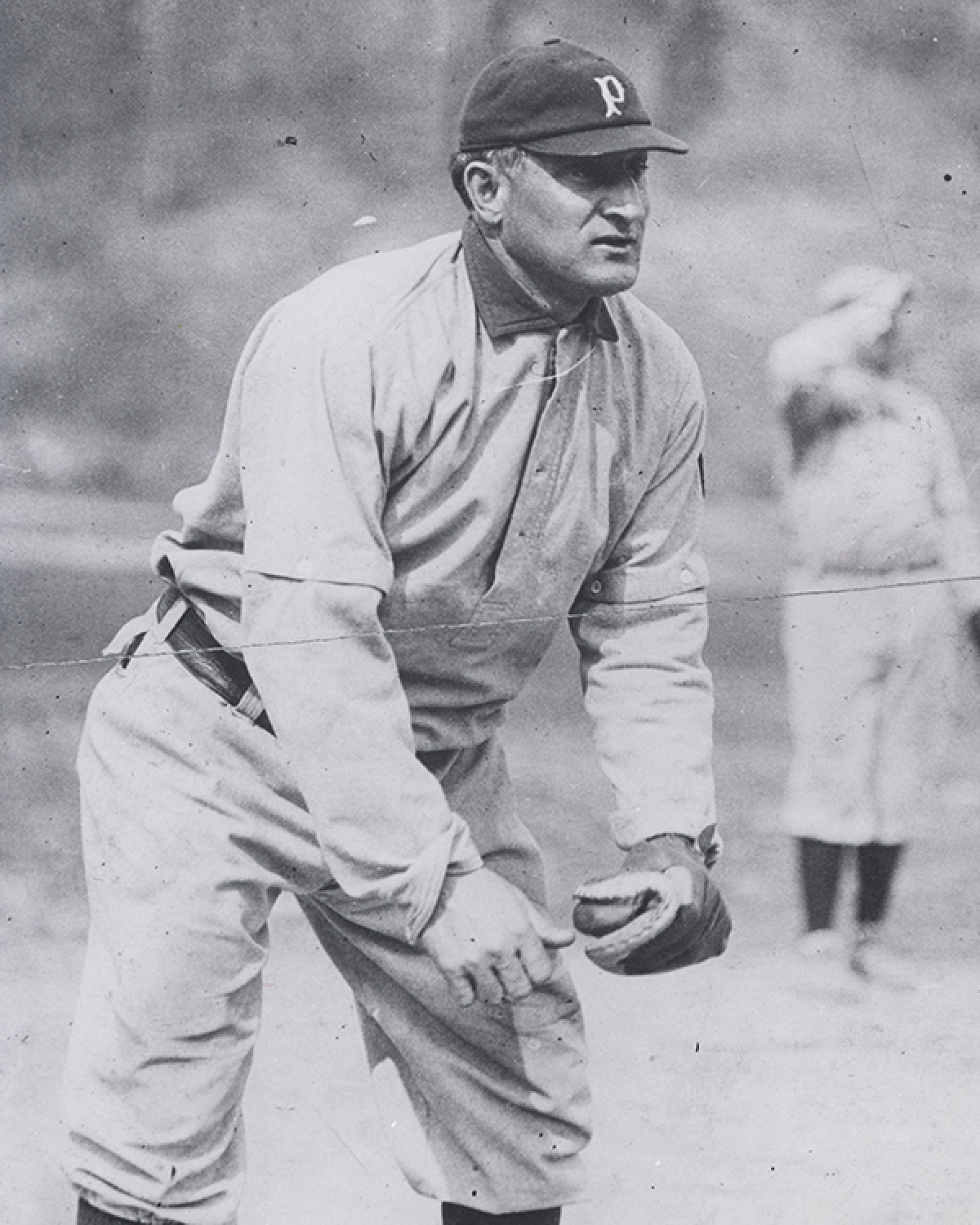
Honus Wagner’s arrival in Pittsburgh ahead of the 1900 season was the byproduct of structural chaos, landing with the Pirates alongside manager Fred Clarke and a massive influx of talent when the Louisville franchise folded. The stocky, bow-legged son of German immigrants didn't fit the classic mold of an agile, graceful shortstop; he possessed massive, barrel-chested strength, exceptionally large hands that scooped up dirt along with the baseball, and an explosive burst of athletic ability that defied his rugged frame.
He quickly changed the senior circuit baseline, winning his first National League batting title during his debut summer in 1900 with a blazing .381 average. This marked the start of a decade of dominance that defined early 20th-century baseball. Known as "The Flying Dutchman,” he set the benchmark for all dead-ball era players, confident in his style and virtually unstoppable. He secured eight National League batting titles, a record that still stands as the gold standard in senior circuit history, and is evenly matched with legendary Tony Gwynn.
When analyzed with modern advanced metrics, his dominance becomes not just impressive but truly extraordinary. Wagner consistently anchored the diamond by leading the National League in positional bWAR an impressive 11 times in his career. Between 1900 and 1912, he never ranked lower than third in the league in overall value, demonstrating an efficiency that seems almost artificially created. During an era when a soft, dark baseball often made deep hits rare, he overwhelmed opponents with his line-drive power, leading the league in slugging percentage six times and total OPS eight times.
Once he reached the basepaths, he unleashed an aggressive, high-leverage running game, pacing the National League in stolen bases five times on his way to 723 career swipes. Defensively, he was a vacuum at shortstop, weaponizing his range and an absolute cannon of an arm to shut down opposing offenses long before anyone conceived of a Gold Glove Award.
That individual brilliance was the engine behind the franchise's first taste of ultimate team success. Wagner pilot-steered the Pirates to three early pennants, culminating in a historic 1909 World Series triumph over Ty Cobb’s Detroit Tigers, where he hit .333 and stole six bases to deliver Pittsburgh its maiden world championship. He remained a fixture in the local lineup until walking away as a player in 1917, concluding his pinstriped journey as the all-time franchise leader in position player bWAR (120.1), runs scored (1,521), and triples (232).
Wagner was also a champion, leading the Pirates to a World Series win in 1909, the first in franchise history. He played until 1917, and is the all-time team leader in bWAR (120.1), Runs Scored (1,521), and Triples (232).
His legacy as one of the twin towers of early baseball history received its ultimate, historic punctuation marks in waves. In 1936, Wagner was elected as one of the "First Five" charter members of the National Baseball Hall of Fame, standing alongside Babe Ruth, Ty Cobb, Walter Johnson, and Christy Mathewson.
His strong connection to the city persisted through a long, multi-decade coaching career. When he retired from active duty on February 16, 1952, the organization immediately retired his jersey number 33, making it the first number to be officially retired in Pittsburgh history. In the spring of 1955, fans dedicated a large bronze statue of him outside Forbes Field. This monument now stands proudly at the home plate entrance of PNC Park, symbolizing the legacy of the greatest Pirate ever.
Comments powered by CComment