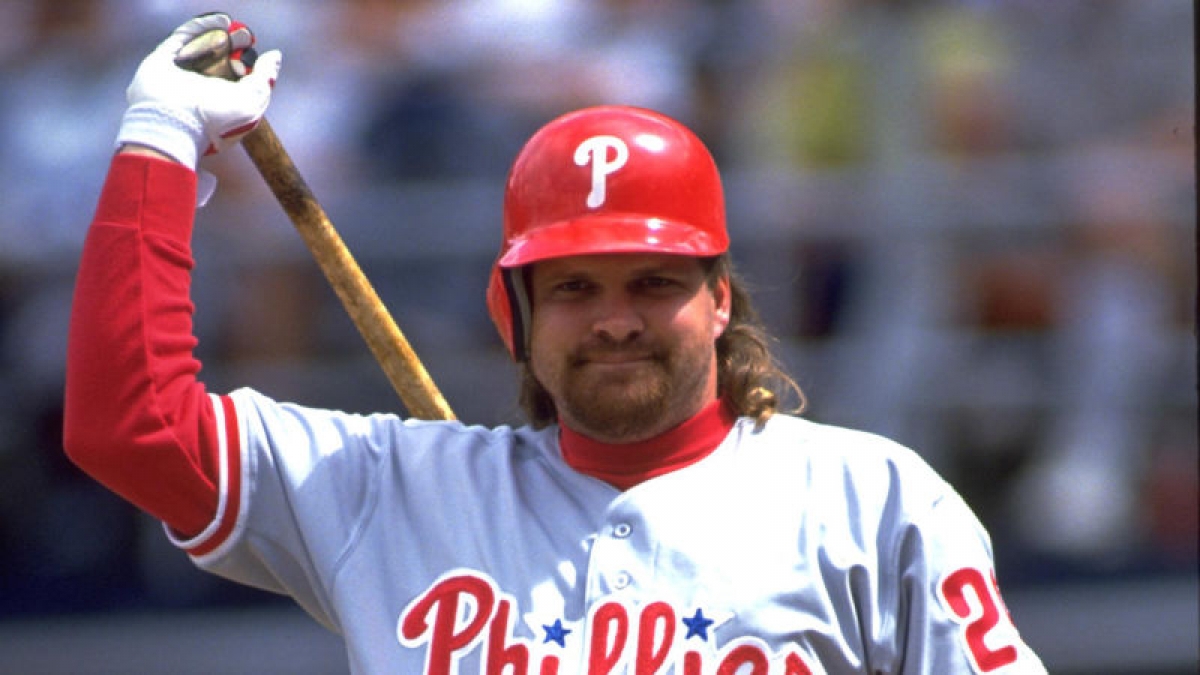
If a baseball roster typically calls for a polished, professional ambassador to represent the franchise, John Martin Kruk was the opposite of that ideal. His appearance, more resembling a guy who wandered onto the field from a local soft-pitch league than an elite athlete, along with his portly build and beer-drinking habits, made him an instant counterculture hero on Broad Street. Despite his rumpled uniform, untamed mullet, and repeated assertion that he was "not an athlete, but a ballplayer," he possessed one of the most refined, efficient left-handed swings of his era—an expert at strike-zone control who led the most colorful clubhouse in franchise history.
His arrival in June 1989 through a trade with San Diego immediately gave the Phillies a top-tier leadoff man. Kruk made reaching base an act of precise skill, using his exceptional eye to neutralize pitchers attempting to expand the strike zone.
During his five-and-a-half seasons wearing red pinstripes, he consistently challenged National League pitchers, posting an impressive .309 batting average and accumulating 790 hits along with 62 home runs across 738 games.
His peak performance and rising national profile occurred during a remarkable three-year period from 1991 to 1993, during which he earned three consecutive National League All-Star selections. In the 1992 and 1993 seasons, Kruk delivered outstanding offensive displays, consistently surpassing the .300 batting average and .400 on-base percentage benchmarks. He ranked as the runner-up in on-base percentage in the National League in those years, setting a career high with 111 walks in 1993, significantly contributing to his team's run production.
His consistent high-volume performance earned him steady recognition as a National League MVP contender, reaching a peak in 1993 when he hit .316, scored 100 runs, and drove in 85, cementing his reputation beyond doubts about his conditioning. Partnered with the legendary Mitch Williams, Kruk became the unmistakable, nationally televised figure of the beloved group of dirt-devils who surprised the baseball world by winning the 1993 National League pennant.
Tragically, at his peak across multiple dimensions, his timeline was suddenly interrupted during spring training in 1994 when he was diagnosed with testicular cancer. Despite bravely returning to play that summer following surgery, the physical strain and ongoing knee issues greatly affected his career longevity. He quietly moved to the Chicago White Sox in 1995 and then unexpectedly retired mid-game after making history by singles-hitting his way into it.
The team inducted Kruk into their Philadelphia Baseball Wall of Fame in 2011.
Comments powered by CComment