
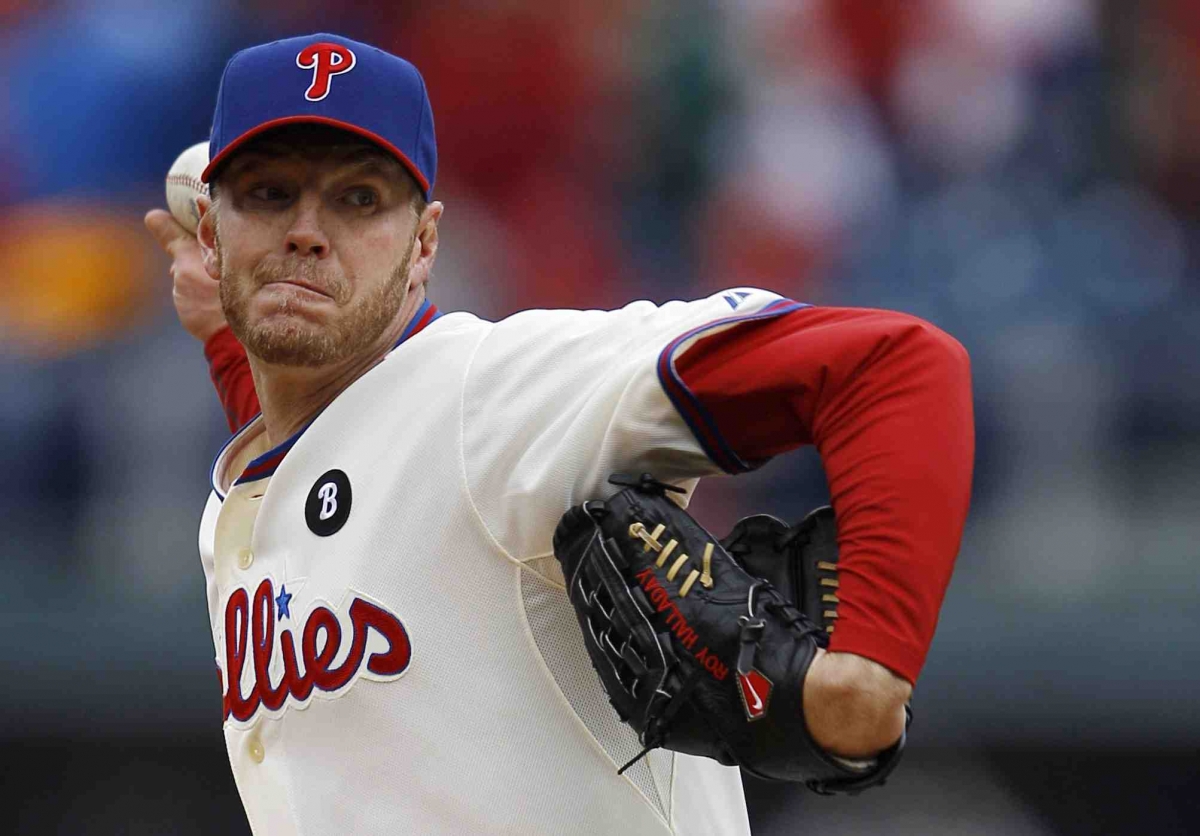


Before Roy Halladay donned a Philadelphia jersey, his reputation as a top-tier player in the modern game was well established. As the reliable and dominant pitcher for the Toronto Blue Jays, "Doc" had already won an American League Cy Young Award and led the league in bWAR for consecutive seasons. He exemplified the ideal old-school workhorse, thriving in an era of strict pitch counts. However, when he was traded to the Phillies before the 2010 season, Halladay managed to elevate his already stellar career into an enduring baseball legend.
His debut campaign in red pinstripes showcased exceptional athletic control. Halladay systematically dismantled National League lineups, achieving a 21-10 record with a stellar 2.44 ERA, leading the majors with nine complete games and four shutouts. On May 29, during that remarkable summer, he delivered a flawless performance by pitching a perfect game against the Florida Marlins. This historic feat secured him the unanimous National League Cy Young Award, placing him among the few to win the honor in both leagues.
Yet, it was his unforgettable introduction to the high-leverage theater of October that permanently altered the archives of the sport. Making the very first postseason appearance of his twelve-year career in Game 1 of the NLDS, Halladay stepped onto the mound at Citizens Bank Park and completely paralyzed the Cincinnati Reds. Armed with a devastating, biting cutter and immaculate spatial command, he carved his way through history to spin a no-hitter, marking only the second no-hit masterpiece in postseason history after Don Larsen’s famed 1956 World Series perfect game.
He carried his front-line dominance into the 2011 season, posting a strong regular season with a 19-6 record and a career-best 2.35 ERA, earning him a close second in the Cy Young voting. Unfortunately, the intense workload needed to maintain that level of excellence took a severe physical toll. Serious shoulder and back injuries caused him to lose much of his signature velocity and movement, diminishing his once-formidable presence to a shadow of itself during two painful, less effective seasons before he officially retired in late 2013.
Halladay would die in 2017 when he crashed his amphibious plane in the Gulf of Mexico. The Phillies would posthumously induct him into their Baseball Wall of Fame in 2018, and the Baseball Hall of Fame chose him the next year.

Comments powered by CComment