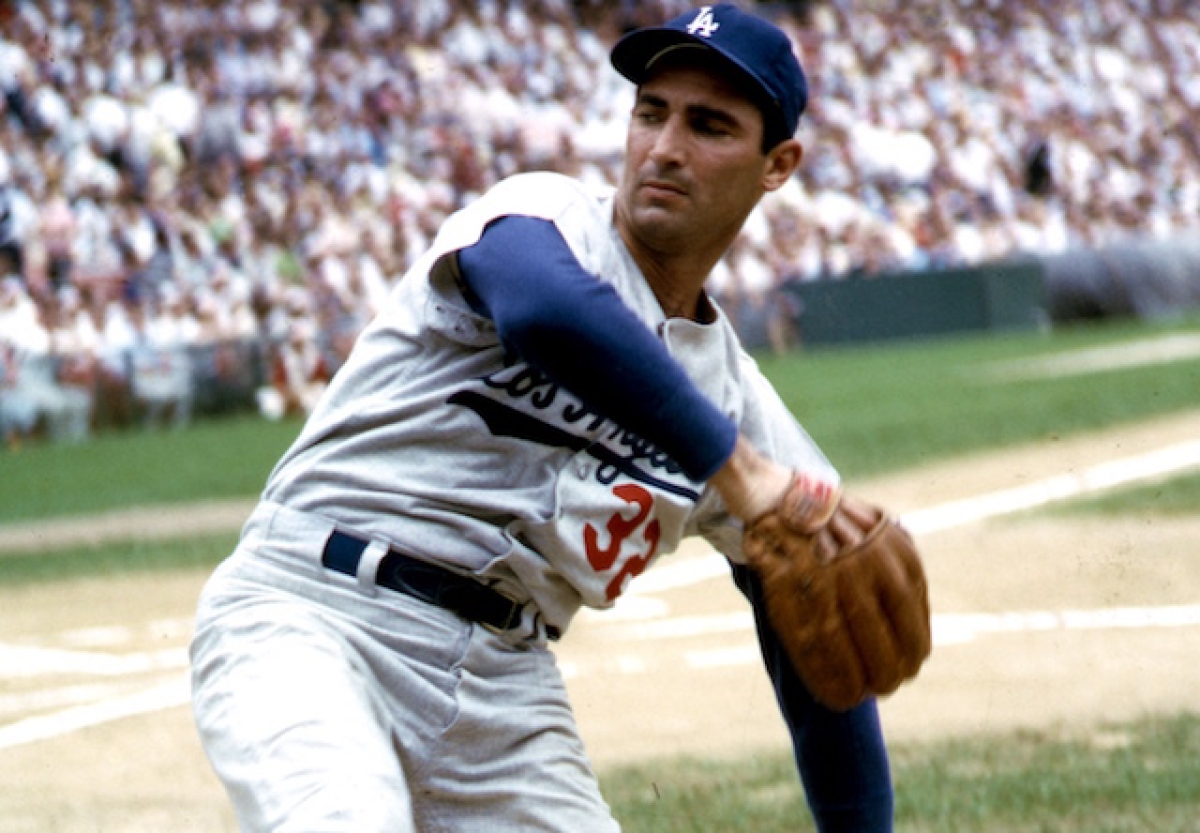
Sandy Koufax arrived in Brooklyn in late 1954 as a "Bonus Baby," a local product from the University of Cincinnati with a fastball that crackled but a compass that often failed him. Because of the rules at the time, his signing bonus forced him directly onto the major league roster, bypassing the seasoning of the minor leagues. For the first six years of his career, he delivered a brand of erratic brilliance, standing as a tantalizing talent who frequently walked as many batters as he struck out.
The early portion of his tenure was defined by a frustrating struggle with control that nearly led him to walk away from the sport. Between 1955 and 1960, he posted a 36-40 record with a 4.10 ERA, marks that reflected a pitcher who would often lose sight of the plate by rearing back too far in his delivery. He showed the organization he was a professional mainstay during the team's 1959 championship run, but it wasn't until a legendary spring training conversation with Catcher Norm Sherry in 1961 that he began to harness his power. By simply easing his effort to improve his accuracy, he transformed from a wild thrower into the most feared southpaw in baseball history.
The advice paid off. That season, Koufax had a breakout year, leading the National League with 269 strikeouts and a 3.00 FIP. He followed that performance with a 1962 season where he won the first of five consecutive ERA titles, posting a stellar 2.54 mark and his first career no-hitter. This steady ascent served as the formal introduction to a period of dominance that arguably remains the greatest four-year stretch ever produced by a pitcher. From 1963 to 1966, he operated at a level of individual recognition that saw him secure three Cy Young Awards and the 1963 National League MVP.
His postseason resume added a layer of legendary status to his career, particularly during the 1963 and 1965 World Series. He proved to be a high-caliber winner by posting a 0.95 career ERA in the Fall Classic, famously winning World Series MVP honors twice. Whether it was striking out 15 Yankees in the 1963 opener or tossing a three-hit shutout on two days' rest to clinch the 1965 title, he became the primary engine behind the franchise's golden era. His value was never more apparent than when he reached for the resin bag in October, turning the biggest stage in sports into his own personal gallery.
The trajectory of his career was tragically cut short by traumatic arthritis in his left elbow, forcing a retirement that stunned the sporting world. He walked away in 1966 following a 27-win season, opting to preserve his long-term health rather than risk permanent injury. He left behind a statistical footprint in Los Angeles that includes 165 wins and 2,396 strikeouts, figures that would have been significantly higher had his body not betrayed him at age 30. He remained a professional icon even in retirement, becoming the youngest player ever inducted into the Hall of Fame at age 36.
The longevity of his peak may have been brief, but the height of that peak left a mark in Blue Heaven that serves as a permanent benchmark for excellence. Departing with four no-hitters, including a perfect game, his status as a foundational pillar of the franchise is beyond question. He carried himself with a quiet dignity that matched his on-mound ferocity, a journey that saw his number 32 retired in 1972 as a tribute to a man who, for six years, was simply unhittable.
With the Dodgers, Koufax compiled 165 wins, 2,396 strikeouts, and three Cy Young Awards.
Comments powered by CComment