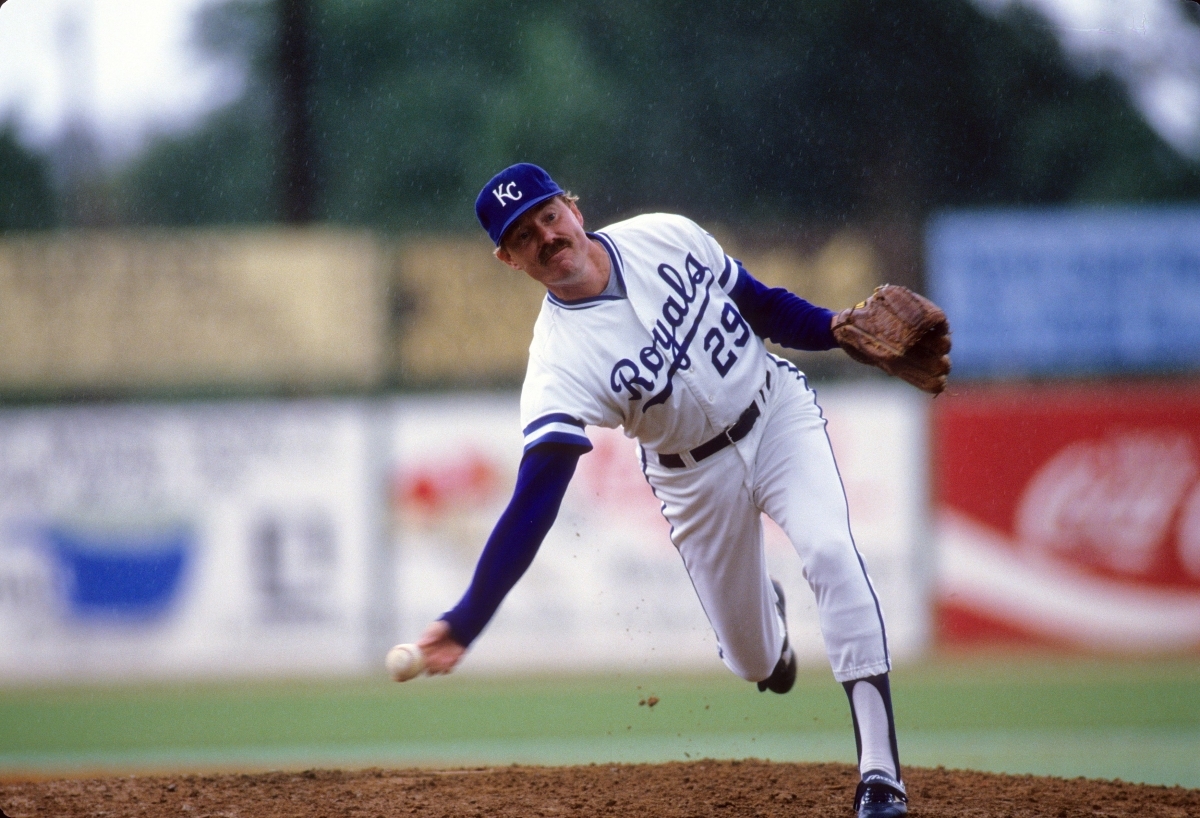
Dan Quisenberry was a machine in an era of flame-throwing closers. While his peers were busy trying to blow the ball past hitters, "Quiz" was busy making them look foolish with a submarine delivery and a sinking fastball he famously nicknamed "Peggy Lee”, because the first time a hitter saw it, they’d ask, "Is that all there is?" For the first half of the 1980s, his pinpoint control and unconventional style turned the late innings at Royals Stadium into a graveyard for American League rallies.
Quisenberry’s ascent in Kansas City began with a definitive tactical shift in 1980. After a solid debut the year prior, his signature submarine style immediately propelled him to a league-leading 33 saves and a fifth-place finish in the Cy Young voting. He was the high-frequency engine that powered the Royals to their first-ever American League pennant, providing a specialized level of efficiency that defied the "fireballer" archetype. He proved that a reliever could become a franchise pillar not by overpowering hitters, but by inducing a relentless stream of ground balls and refusing to grant free passes.
The middle of his career was defined by a four-year run of high-leverage dominance that remains an outlier in relief history. Between 1982 and 1985, Quisenberry led the American League in saves each season and won four consecutive Rolaids Relief Man awards. In 1983 alone, he set a then-MLB record with 45 saves while maintaining a microscopic 1.94 ERA across 139 innings, a workload that would be unthinkable for a modern closer. He was a model of steady-state reliability, finishing as the runner-up for the Cy Young in both 1983 and 1984, proving that his specialized craftsmanship was respected as much as any starter’s volume.
The final chapters of his story in Kansas City culminated in the 1985 "I-70 Series." Quisenberry was a model of veteran poise throughout the postseason, eventually earning the win in the legendary Game 6 that sparked the Royals' comeback to win their first World Series title. However, the heavy workloads of his peak years led to a rapid decline; his effectiveness eroded to the point where the club released him midway through the 1988 season. He departed with 238 saves in a Royals uniform, a total that served as the franchise gold standard for decades.
The story in Kansas City reached its final punctuation in 1998 when the Royals inducted him into their Hall of Fame. It was a bittersweet celebration, as Quisenberry passed away later that year, but his legacy as a witty, eccentric, and utterly dominant tactician remains etched into the team's identity.
With the Royals, Quisenberry compiled 238 saves, five Rolaids Relief Man awards, and a World Series ring (1985).
Comments powered by CComment