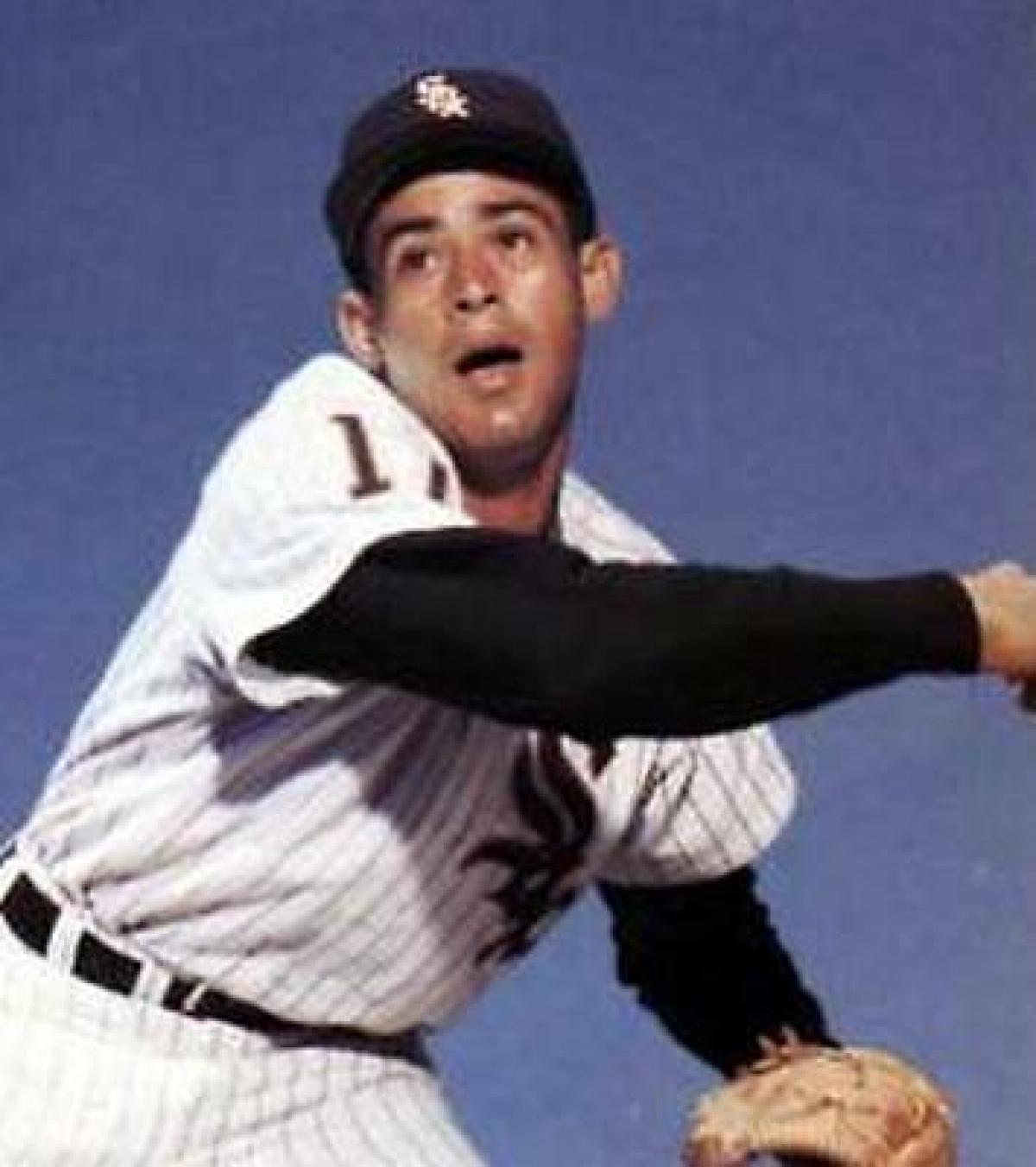
When Luis Aparicio arrived on the South Side in 1956, he didn't just fill a hole at shortstop; he ignited a revolution. As the first Latin American player to be named Rookie of the Year, he immediately signaled that the game was changing. He led the American League with 21 stolen bases in his debut season, a feat he would repeat for the next eight consecutive years. In an era where many teams were content to station stationary power hitters on the corners, Aparicio was a blur of motion, forcing pitchers into mistakes simply by his presence on the bag. He was the kinetic energy that powered the White Sox’s aggressive identity throughout the late 50s.
The middle of his Chicago residency was defined by a defensive masterclass that ranks among the very few in the history of the sport. Aparicio was a human highlight reel at shortstop, a six-time Gold Glove winner during his first stint with the Sox. His defensive bWAR of 20.7 in Chicago alone is a staggering figure, dwarfing those of contemporaries often cited for their gloves. He wasn't just flash; he was fundamental, leading the league in putouts, assists, and double plays turned with a regularity that became monotonous for opposing hitters. If the ball was hit toward the left side of the infield, the result was almost always an out.
However, calling a spade a spade requires looking at the other side of the ledger. While his glove and legs were elite, his bat lived in a different reality. Aparicio struggled to draw walks or drive the ball, posting a modest .319 on-base percentage and a .348 slugging clip during his peak Sox years. He was a high-volume hitter who relied on contact and speed to generate value, and while his 1,576 hits for the franchise are impressive, his lack of traditional statistical dominance at the plate is the reason his ranking often hits a ceiling. He was a specialist, perhaps the greatest defensive specialist of his generation, but he was never a middle-of-the-order threat.
The trajectory of his career took him to Baltimore in 1963, but the South Side wasn't finished with him. In a rare "return of the king" moment, he was traded back to Chicago in 1968 for three more seasons. While he wasn't as quick as the rookie who had taken the city by storm twelve years earlier, he remained an elite fielder and a cerebral leader, earning one final All-Star nod in 1970 before being dealt to Boston to finish his legendary career.
Luis Aparicio’s walk toward the exit concluded as the most decorated Venezuelan player in history. In 1984, the same year the White Sox hoisted his number 11 to the rafters, he became the first of his countrymen to be inducted into Cooperstown. He arrived as a skinny kid from Maracaibo and left as a global icon, the man who proved that a shortstop’s greatest weapon wasn't his bat, but his ability to make the field feel smaller for the opponent and larger for himself.
Comments powered by CComment