
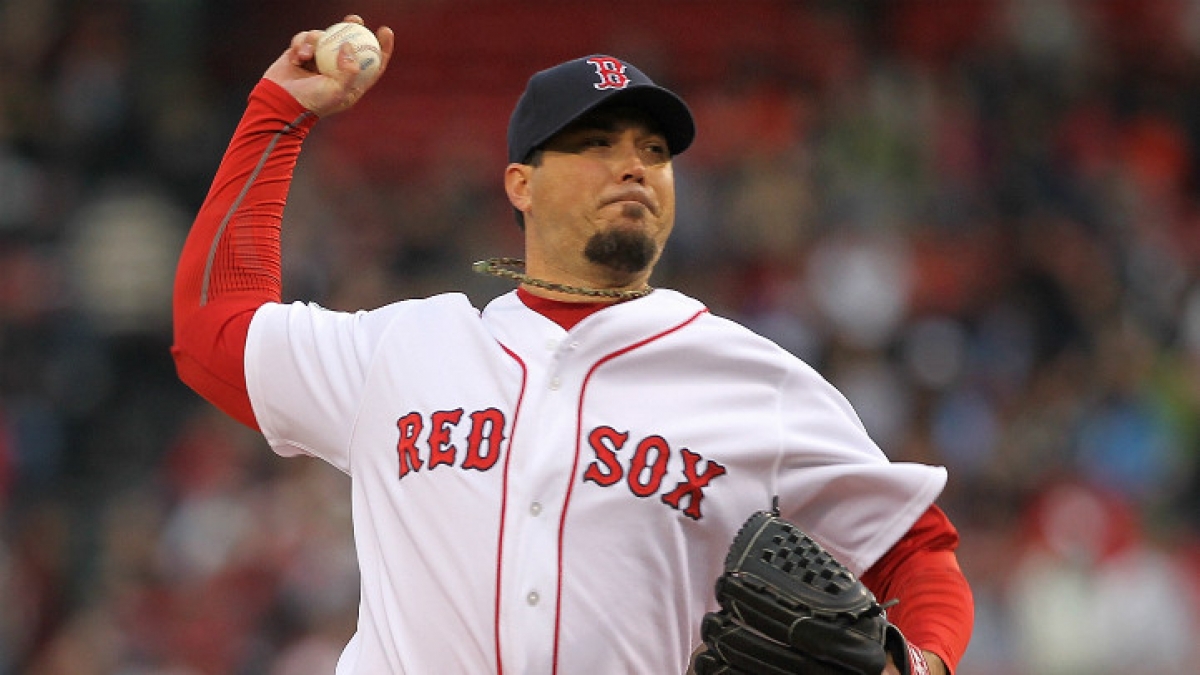



Josh Beckett arrived in Boston in 2006 with a reputation already carved in pinstriped stone. As a 23-year-old with the Marlins, he had famously walked into Yankee Stadium and shut out the Bronx Bombers to clinch a title, a moment of pure intimidation. When he joined the Red Sox as the centerpiece of a blockbuster trade, Boston didn't just get a pitcher; they got a firebrand who lived for the highest possible stakes. After a turbulent first year adjusting to the American League, Beckett found his rhythm in 2007, and the league had no answer for him.
That 2007 season was Beckett’s apex. He stormed through the summer to a 20–7 record, becoming the first Red Sox pitcher to reach the 20-win plateau in nearly a decade. He finished as the runner-up for the Cy Young Award, but his true value was revealed in the postseason. Faced with a 3-games-to-1 deficit against Cleveland in the ALCS, Beckett took the mound in Game 5 and delivered a cold-blooded performance, striking out 11 over eight innings to save the season. He was named the ALCS MVP, having essentially willed the Red Sox back to the World Series.
Beckett’s efficiency during that October run was legendary: he went 4–0 with a 1.20 ERA, striking out 35 batters while walking only two. He was simply unhittable when it mattered most. He would go on to earn two more All-Star nods in Boston (2009 and 2011), continuing to anchor the rotation with a blend of power and precision. Even in 2011, he posted a stellar 2.89 ERA, proving that when his mechanics were locked in, he remained one of the most difficult puzzles for hitters to solve.
Though his tenure in Boston ended with a trade to the Dodgers in 2012, Beckett’s legacy is secured by the hardware he brought to Fenway. He left the club with an 89–58 record and 1,108 strikeouts, but his impact is best measured in the silence he forced upon opposing crowds in October. He was the quintessential big-game hunter, a pitcher who didn't just participate in championship runs; he dictated them.

Comments powered by CComment